



How to Maximize Your First 90 Days in a New Procurement Org
Starting a new procurement role? Here’s how to hit the ground running in your first three months.

Receive the latest updates on growth and AI workflows in your inbox every week
There’s nothing quite as exciting as the first day on a new job: Walking through the doors of a new building, sitting down to a new computer, and finding your way around the maze of offices and cubicles that will soon feel familiar.
So many procurement professionals feel the pressure to “prove their worth” in their organizations right away. That’s exactly why we wanted to get to the heart of what procurement professionals need as the industry changes. To do this, we sat down for an in-depth interview with Tom Mills, procurement specialist and voice behind the newsletter Procure Bites.
Your first quarter on the job sets the tone for how your tenure will go in procurement—and hopefully, establish strong relationships with your team, your suppliers, and your executive leadership. Let’s take a look through a solid plan for your first 90 days on the job.
How to make the most of your first 90 days in a new procurement organization
The excitement from starting a new role quickly turns to overwhelm. There’s a reason HR professionals often talk about “drinking from a firehose” the first few weeks. There’s so much to learn—not just for your role, but for starting any job, like who to ask about computer chargers, where the bathrooms are, and how to use Slack, Teams, or Outlook.
“I absolutely believe that the best procurement professionals take a more relaxed approach,” says Tom. “That doesn’t mean they’re not working hard every day. It means they’re not so focused on the pressure to deliver savings or prove their value that they move too quickly. I think you really need to slow down to speed up.”
So, take a deep breath. It takes time to truly settle in to a complex role, and while you should certainly not ignore any quick wins you see, know that the time you spend now in understanding the business fully will pay off later. “I wouldn’t necessarily expect there to be actual, tangible outputs even within the first six months,” Tom acknowledges. “The best value that procurement can deliver is long-term value. So focus on building the best plan you can to achieve that.”
To do that, break down your first 90 days into three month-long chunks:
- The first 30 days should be spent understanding the business needs and how procurement functions within the organization.
- The next 30 days should be spent understanding your supply base and digging into the core data around your suppliers, risks, and current contracts.
- Finally, you should meet with your suppliers during the last thirty days to understand those relationships.
Then, bring together the qualitative and quantitative data you’ve collected to create a procurement plan you’ll present to the executive team. That’s when you’ll start moving forward on recommendations from stakeholders, suppliers, and your own analysis.
Tom breaks down your 90-day plan month by month. We’ll dig deeper into each of these in a moment, but here’s a quick overview to start:
| Day 0-30 | Day 30-60 | Day 60-90 |
| Goal: Understand the internal business needs | Goal: Understand the data about your supply base | Goal: Understand your supplier relationships |
| Action Items: Go through traditional onboarding and get settled Meet the extended team Create stakeholder map | Action Items: Get a handle on the procurement data Map out major supplier landscape Forecast risks, opportunities, and current contracts | Action Items: Meet with your suppliers Assess what’s working and what could be improved with each supplier from their perspective (and yours) Prepare plan for executive approval |
| Checkpoint: By the end of these 30 days, you should know the basics of the business model and product and start understanding the biggest pain points from your business stakeholders. | Checkpoint: By the end of these 30 days, you should know the basics of your supplier base and start finding opportunities for improvement. | Checkpoint: By the end of these 30 days, you should know how your internal pain points and supplier pain points (qualitative) intersect with your supplier and contract data (quantitative) to build a savings/opportunity plan |
Day 0-30: Know the needs of the business and your stakeholders
If there’s one thing you can remember about the first 30 days, it’s not to try to do too much, too soon. “Don’t be too structured those first few weeks,” advises Tom. “You’ve got to give yourself time to settle in and understand the basics.”
But rather than start with procurement, start with the business:
- What does the overall organizational structure look like?
- What tools does the team already use?
- What products and services do you sell?
- What is the product roadmap and big-picture growth plan?
- What are the goals and key objectives of the business over the next year?
“That flips the perspective in terms of what’s important to your stakeholders,” Tom explains. “If you can understand what drives the business, then you can understand how procurement facilitates that growth both short-term and long-term.”
To do this, he recommends meeting with as many people as possible that procurement serves—including legal, marketing, sales, IT, and product. “You want to talk to people who really feel the pain points, not just executive leaders,” he says.
When you chat with new colleagues, keep it informal. This is not the time to pitch your pre-made plan or talk about why procurement matters. The more you can listen about what they care about, the better. “I have a very informal coffee conversation with everyone, where I’m just trying to understand what their key objectives are, and what’s preventing that from happening. Then, I tell them the process of building a procurement plan, and set up time to check in with them again in six weeks or so. That helps bring them on the journey with you, so you’re not coming in and building something in a silo. You’re giving them a vested interest in your success.”
Action items for the first 30 days
This month is all about settling in and getting a picture of the internal workings of your new organization. What does that look like in terms of deliverables?
- First, a stakeholder map, so you can understand who’s who that you’ll be working with.
- Second, look for patterns in pain points across your stakeholders you interview and summarize them in a one or two-page brief. Refer back to this as you build out your plan.
- Finally, schedule time with executive leadership at the end of 90 days to present your plan up front so you’re not scrambling at the last minute.
Day 30-60: Know your procurement and contract data inside and out
The second thirty days are all about your supply base. This is the foundation of your procurement team, so take your time digging through all of the data—including figuring out whether or not you have the right data—so you can understand the complete picture of your suppliers.
With so much data on your hands, use the 80-20 rule: Find the 20% of suppliers driving the most spending to find those opportunities. Within your CLM, you’ll want to find out:
- Which suppliers are the biggest spends?
- How much of those big cost centers are addressable?
- What spending is in-house vs. third-party?
- What are the most important upcoming expiration dates?
- Who are the key stakeholders that manage those relationships?
“This is where a really great contract lifecycle management system like Ironclad can help,” says Tom. “You need the big picture right now. A big mistake I’ve seen procurement professionals make is trying to understand every single supplier, and that’s not going to work.”
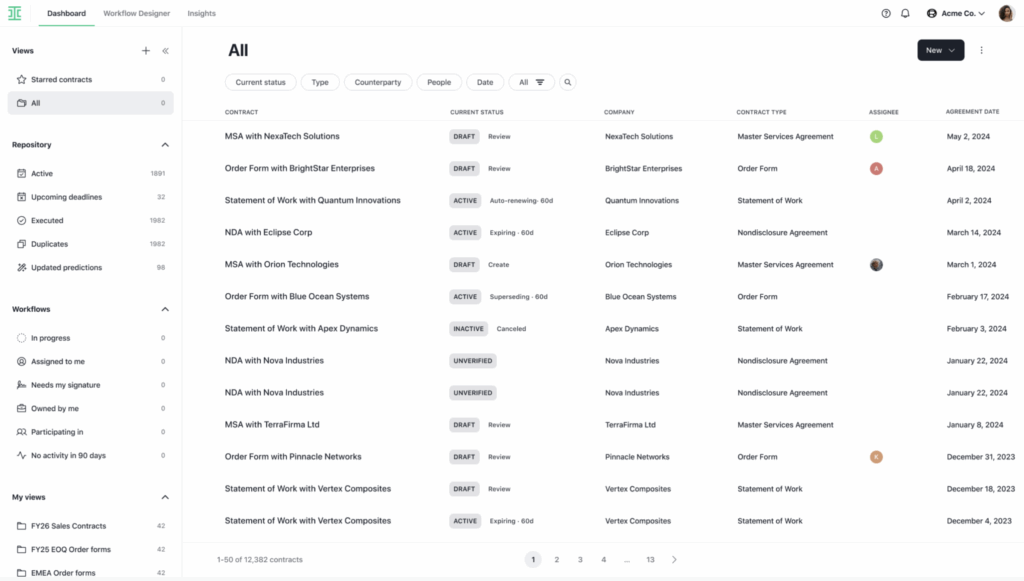
You want to have a clear understanding of your major suppliers and what services they provide before trying to find all the one-off opportunities hiding in your contracts. Mapping this out will also help you prioritize which suppliers to meet with first, and how to approach them.
“You don’t want to approach suppliers before you’ve spoken to your key stakeholders about them,” says Tom. “Once you know those big suppliers and what spend looks like, reach back out to the appropriate managers to get a sense of the relationship.”
Action items for the second 30 days
This month is all about digging deep into your contract data to understand what you’re working with as an organization and any quick wins that might exist. That means you’ll want to:
- Pull big-picture spend reports to understand your biggest suppliers and how much you’re spending with them.
- Identify any immediate opportunities from those suppliers so you know up front where to start prioritizing your meetings.
Day 60-90: Know your supplier relationships
Finally, use the remaining 90 days to meet with your suppliers alongside your key relationship manager or relevant organizational stakeholder. Your goal with these meetings is not to come in swinging with re-negotiation ideas but to position yourself as a partner. Similar to your conversations with internal stakeholders, listen to their pain points first.
“I ask suppliers to come prepared with what’s working and what’s not, but I always stay open in these conversations,” says Tom. “You don’t want to be Big Bad Procurement coming in.”
He always asks suppliers three questions in this meeting:
- Open with: What’s your take on the relationship? What’s working, what’s not?
- What are some of the biggest opportunities we can work together more effectively?
- What’s on their roadmap for innovation in the next year or five years that could benefit the business?
“Those three questions are deliberately meant to position a partnership,” says Tom. “You’re looking to say, ‘I respect you.’ Your role is to try to make life easier for stakeholders in the business. So actually, if we can get a really good supplier that really helps make life easier than that, in itself, has a benefit to the organization.”
Action items for the third 30 days
This month is all about supplier relationships. Done right, these meetings will give you what’s working and what’s not with your biggest suppliers so you can understand how to move forward. That results in:
- Just as you did in the first 30 days, look for patterns in pain points across your suppliers you interview and summarize them in a one or two-page brief.
- Match this against the internal pain points from the first 30 days and see if there is any overlap, or mismatch between them.
- Finally, combine this qualitative data with the quantitative data from the second 30 days to build your procurement plan.
After the first 90 days: Present your plan to your executive team
All this is leading toward a procurement plan to present to your executive leadership team. “Now is the time to tell the story of what you’ve heard over the past sixty days and what that means for the next year, two years, three years in procurement,” says Tom. “This is not necessarily saying, ‘I’m going to save X percent,’ but to tell the story about the pain points you’ve heard and your plan to solve them.”
Tom advises positioning this plan as a conversation, rather than a presentation. “I put together the slides as a pre-read, with all the data, and then use one slide to tell the story of what I’ve learned and what we’ll do next before opening it up to the room,” he explains. “You don’t want them to get sidetracked by the details. That’s not where the insights are at this point. You want to keep it high level and show them what the plan is, and explain why you’ll need the time to do it right.”
Spend your first 90 days collecting qualitative and quantitative data
Rather than try to execute right away, take a measured, deliberate approach to your first 90 days. Focus instead on collecting as much data as you can—both qualitative data, like a temperature check on your supplier relationships, and quantitative data, like evaluating your spend opportunities.
With the right CLM, you can gather all the data you need to understand who your biggest suppliers are and where the spending opportunities lie. Rather than dig around six different sources and rely on contracts hidden on local desktops, a CLM stores it all in one place, giving you a big-picture understanding of your supplier relationships—so you can hit the ground running right away.
To learn more about Ironclad’s procurement contracting capabilities, request a demo today.
Ironclad is not a law firm, and this post does not constitute or contain legal advice. To evaluate the accuracy, sufficiency, or reliability of the ideas and guidance reflected here, or the applicability of these materials to your business, you should consult with a licensed attorney.


