



Table of Contents
- What is an aleatory contract?
- Key characteristics of aleatory contracts
- Aleatory vs. unilateral contract
- Are aleatory contracts enforceable?
- Types of aleatory contracts
- Drafting and managing aleatory contracts effectively
- Managing aleatory contracts at scale
- Frequently asked questions about aleatory contracts
Want more content like this? Sign up for our monthly newsletter.
Key takeaways:
Recognize aleatory contracts by identifying agreements where one party’s performance obligation depends on an uncertain future event beyond either party’s control, and where the exchange of value between parties is inherently unequal based on whether the triggering event occurs.
Understand that aleatory contracts remain legally enforceable despite unequal value exchange, because valid consideration only requires that parties exchange something of value, not that the values be equal in amount.
Draft aleatory contracts with precise definitions of triggering events, payment terms, payout calculations, coverage exclusions, and missed payment consequences using plain language, as ambiguous event definitions frequently lead to litigation and disputes.
Implement contract management software to systematically track obligations, renewal dates, and triggering events across multiple aleatory contracts, as poor contract management typically costs organizations five to nine percent of annual revenue and manual tracking breaks down at scale.
How often do you sign a contract hoping you’ll never actually need to use it? That’s the reality of an aleatory contract—an agreement where one party’s obligation to perform depends on an uncertain future event beyond either party’s control, such as death, an accident, or a natural disaster.
Companies use aleatory contracts to transfer financial risk. Insurance policies, annuities, and guarantees all fall into this category.
This isn’t a new concept—these contracts originated in ancient Roman law as agreements whose fulfillment depended on chance. Early examples included speculative investments, gambling contracts, insurance, and life annuities.
What is an aleatory contract?
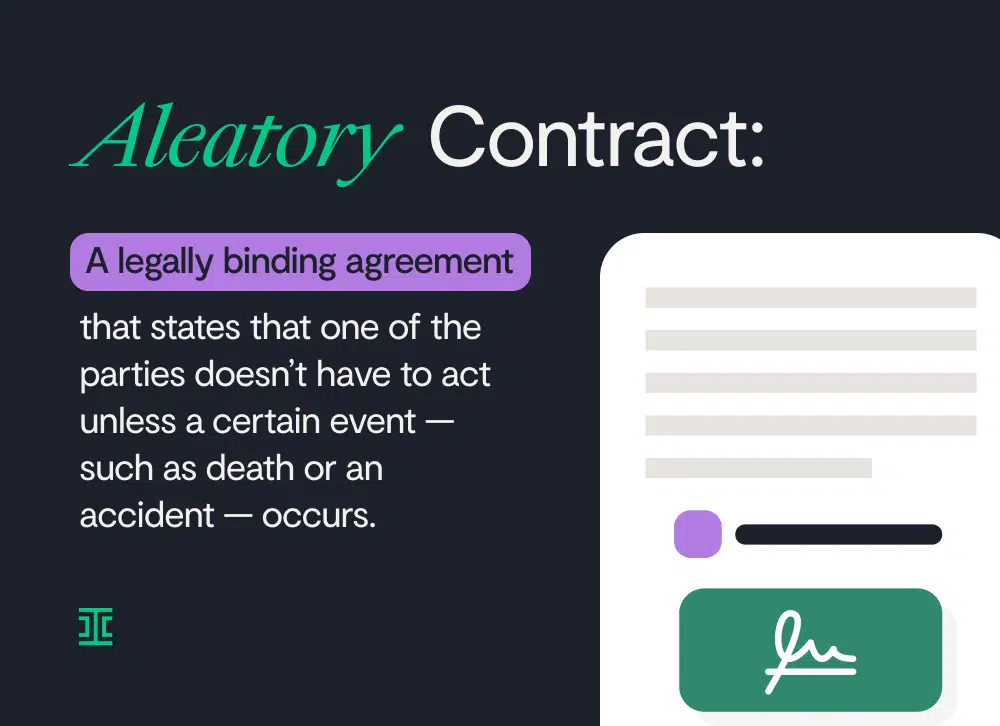
At its core, an aleatory contract is a legally binding agreement where one party’s performance obligation is triggered only by a specific uncertain event.
These contracts have two defining features. First, the triggering event must be beyond either party’s control. Second, the exchange of value between parties is inherently unequal—the benefits received may far exceed or fall short of the payments made.
The primary purpose of aleatory contracts is risk transfer. Individuals and organizations use them to protect against financial losses from unpredictable events. An insurance policyholder might pay premiums for years without receiving a payout, or they might receive benefits worth far more than their total premium payments after a single covered event.
Aleatory contracts don’t follow a standard template. Event definitions vary significantly between agreements. Life insurance policies illustrate this variation—most exclude suicide during the policy’s first two or three years, while some provide full coverage after that waiting period expires.
Key characteristics of aleatory contracts
If you’re trying to figure out whether an agreement is an aleatory contract, there are a few specific traits to look for. Unlike standard business agreements where both sides know exactly what they’re getting, aleatory contracts are built around the unknown.
Uncertainty
The defining feature of an aleatory contract is that it hinges on an uncertain future event. Neither party knows for sure if or when the triggering event will happen. If the event never occurs, the contract simply runs its course without the major obligation ever being triggered.
Conditional obligations
In a typical contract, you pay for a service and the other party provides it. In an aleatory contract, the obligation to perform is conditional. One party only has to fulfill their end of the bargain—like paying out a claim—if the specific event outlined in the contract actually takes place.
Risk allocation
These contracts are fundamentally about managing and transferring risk. One party assumes the risk of a potential loss in exchange for a steady, smaller payment. It’s a way to protect against catastrophic financial hits by shifting the burden to an entity equipped to handle it.
Unequal exchange of value
In most contracts, the goal is a fair and equal exchange of value. Aleatory contracts are different. You might pay premiums for decades and never receive a payout, meaning the insurer gets more value. Or, you might pay one month’s premium and experience a massive loss, meaning the insurer pays out far more than they collected. The value exchanged is almost always unequal.
Aleatory vs. unilateral contract
It’s easy to confuse aleatory contracts with unilateral contracts, but they function differently in practice.
A unilateral contract is a one-sided promise. One party offers something of value if the other party performs a specific action. Think of a reward for a lost dog—you only pay if someone actually finds the dog. The second party isn’t obligated to look for the dog, but if they do, you have to pay.
An aleatory contract, on the other hand, involves mutual agreements from the start, but the major performance is triggered by an external, uncertain event. Both parties are bound by the contract immediately—for example, you must pay your monthly premiums, and the insurer must provide coverage—but the massive payout only happens if the unpredictable event occurs.
Are aleatory contracts enforceable?
Yes, aleatory contracts are legally enforceable. They contain all six essential elements required for any binding contract: offer, acceptance, awareness, capacity, legality, and consideration.
You might be wondering if this unequal exchange of value makes the agreement void. Here’s the thing—it doesn’t invalidate these contracts. Consideration in contract law refers to something of value that parties agree to exchange—whether money, services, actions, or promises. The consideration doesn’t need to be equal in amount, only present and agreed upon.
Aleatory contracts provide valid consideration through risk protection. The insured party receives coverage against potential losses. The insurer receives premiums and assumes calculated risk. Both parties exchange something of value, which satisfies the consideration requirement.
Types of aleatory contracts
Insurance policies
Insurance policies are the most common type of aleatory contract, with U.S. premiums alone totaling $1.76 trillion in 2024. Policyholders pay regular premiums in exchange for coverage, but receive no payout until a covered event occurs. When a covered event does happen, the payout often exceeds the total premiums paid.
Five main insurance types function as aleatory contracts:
Life insurance protects dependents from financial hardship when an insured family member dies. Beneficiaries—spouses, children, or parents—receive a payout that replaces lost income and covers expenses.
Homeowner insurance covers property damage and loss from disasters like fires, storms, or theft—events that drove $137 billion in global insured losses in 2024. It protects one of your largest financial assets from catastrophic loss.
Health insurance pays for medical procedures, treatments, and emergency care. Without coverage, a single serious illness or injury could cost hundreds of thousands of dollars.
Long-term disability insurance replaces income if an illness or injury prevents you from working. It maintains your standard of living when you can’t earn a paycheck.
Automobile insurance protects against liability from accidents. Most jurisdictions require it, and without it, you could lose personal assets if found liable for injuries or damages.
Life annuities
Annuities are contracts that convert a sum of money into a guaranteed future income stream. Financial institutions offer them primarily as retirement planning tools that protect against outliving your savings.
Every annuity moves through two distinct phases. The accumulation phase is when you invest money into the annuity, either as a lump sum or through regular payments. The annuitization phase begins when the financial institution starts paying out guaranteed income, either for a set period or for the rest of your life.
Annuities come in two main types based on when payments begin.
Immediate annuities convert a lump sum into income payments that start right away. They work well for lottery winners, settlement recipients, or retirees with a large sum to invest. Tax applies only to earnings, not your original investment. You start receiving supplemental income immediately after purchase.
Deferred annuities delay income payments until a future date you choose. They offer three retirement planning advantages. You can contribute unlimited amounts annually. Your beneficiaries receive your contributions plus investment earnings if you die before payments begin. You pay income taxes only when you withdraw money, letting earnings grow tax-deferred.
Both immediate and deferred annuities can be structured as fixed or variable. Fixed annuities guarantee set payment amounts on a regular schedule. Variable annuities tie payments to investment performance—higher returns mean larger payments, but poor performance reduces payouts.
Financial derivatives
In the corporate world, financial derivatives often function as aleatory contracts. These are financial instruments whose value relies on an underlying asset, like a stock, bond, or commodity. Options and futures contracts are common examples—exchange-traded derivatives alone surpassed 62 billion contracts in May 2026. The payout depends on unpredictable market movements, meaning one party might see a massive return while the other takes a loss, all based on events outside their direct control.
Guarantees
A guarantee is a three-party aleatory contract where a bank (the guarantor) promises to pay a beneficiary if a counterparty (the principal) fails to meet contractual obligations.
The guarantee protects the beneficiary from non-performance risk. If the principal defaults, the beneficiary demands payment from the guarantor. The guarantor then pursues payment from the principal to recover the amount paid.
Three common guarantee types serve different business needs:
Demand guarantees let banks manage and price non-performance risk. The beneficiary can demand payment immediately upon the principal’s failure to perform, without proving damages first.
Personal guarantees protect lenders when financing small businesses. Business owners pledge personal assets as backup payment sources if their companies cannot repay loans.
Upstream guarantees occur when subsidiary companies guarantee parent company debt. Parents use these when subsidiaries hold most corporate assets, giving lenders access to those assets as security.
Drafting and managing aleatory contracts effectively
Aleatory contracts contain more conditions and contingencies than standard agreements. Their reliance on uncertain future events means every term needs precise definition. If you want to reduce ambiguity and disputes, consider taking these two drafting principles into account.
Be detailed and direct
Be specific about triggering events and payment terms. Your contract must clearly define which events activate obligations, how much parties must pay to secure coverage, how payouts are calculated, which circumstances void coverage, and what happens when parties miss payments. Ambiguous event definitions lead to litigation—”death” might seem straightforward until suicide, assisted death, or missing person cases arise.
Use plain language and define every term. Straightforward syntax and explicit definitions prevent misinterpretation. Each technical term, time period, and condition should have a clear meaning that non-lawyers can understand. Complex language creates disputes over contract interpretation.
Use contract management software to track obligations and stay compliant
Imagine you have a growing portfolio of aleatory contracts to manage. When you’re juggling dozens of policies, annuities, and guarantees with different triggering events and renewal dates, manual tracking quickly breaks down. The financial impact of this is significant—organizations typically lose five to nine percent of their annual revenue due to poor contract management, according to our 2025 Legal Operations Field Guide.
Most contract lifecycle management (CLM) platforms help teams stay on top of complex obligations—they offer repositories that store all your aleatory contracts in one searchable location to prevent value leakage. You can track which events trigger which obligations, set renewal alerts, and control access based on user roles. Instead of hunting through email threads for policy terms, you can pull up any contract detail in seconds.
Most CLM platforms also include workflow tools for contract drafting and approvals, like workflow designers that handle this without requiring long implementation times or technical expertise. Team members only need to upload an aleatory contract template, tag fields as needed, and add approvers and signers to create and launch contract generation and approval processes.
Built-in guardrails also help ensure your team maintains 100% contract compliance.
Managing aleatory contracts at scale
Aleatory contracts transfer risk through conditional obligations triggered by uncertain events. The three most common types—insurance policies, annuities, and guarantees—all share this structure: one party pays premiums or fees, while the other party performs only if specific conditions occur.
Managing these contracts requires attention to precise definitions and systematic tracking. When you’re handling multiple policies with different triggering events, renewal dates, and payout conditions, centralized contract management prevents missed obligations and disputed interpretations.
Most CLM platforms can track obligations and automate renewal alerts—our platform handles this while also letting you draft, review, and analyze aleatory contracts from a single system. The right tools make a measurable difference; as teams standardize their contract workflows, the average days to execute a contract became five percent faster year over year, according to our 2026 Contracting Benchmark Report. Most CLM platforms offer basic tracking—our platform lets you manage complex conditional contracts at scale, so request a demo today to see it in action.
Frequently asked questions about aleatory contracts
An aleatory contract is an agreement where the performance of one or both parties depends on an uncertain, unpredictable future event. The most common example is an insurance policy, where the insurer only pays out if a specific event, like an accident or natural disaster, occurs.
In a commutative contract, both parties know exactly what they are giving and receiving from the start, and the exchange of value is generally equal. In an aleatory contract, the exchange of value is unequal and depends entirely on chance or an unknown future event.
Yes, virtually all insurance policies are aleatory contracts. Whether it is life, health, auto, or property insurance, the core mechanism relies on the policyholder paying a known premium in exchange for a conditional payout triggered by an unpredictable event.
Absolutely. The contract is still valid and binding even if the uncertain event never happens. For example, if you pay for auto insurance for 10 years and never get into an accident, the contract was still aleatory. You received the protection and coverage, even though the massive payout was never triggered.
Look for conditional language tied to external events. If the contract outlines a scenario where one party’s major obligation (like a large payment) is only required if a specific, unpredictable event happens, you are likely looking at an aleatory contract. You will also notice that the value exchanged between the parties is intentionally unequal.
Ironclad is not a law firm, and this post does not constitute or contain legal advice. To evaluate the accuracy, sufficiency, or reliability of the ideas and guidance reflected here, or the applicability of these materials to your business, you should consult with a licensed attorney. Use of and access to any of the resources contained within Ironclad’s site do not create an attorney-client relationship between the user and Ironclad.