
Table of Contents
- What is contract review AI?
- What can contract review AI do?
- 5 ways contract review AI can transform your legal department
- Use cases for other departments
- Key considerations for using contract AI software
- AI for contract review video
- Bonus: contract review AI FAQ
Want more content like this? Sign up for our monthly newsletter.
Key takeaways:
- AI contract review software saves time, reduces human error, and increases visibility into clause usage to enable optimization
- AI is a powerful tool that improves the contract review process, but it’s not a replacement for human expertise
- Chosen AI tools must ensure data security and confidentiality
Tedious tasks are rarely the most fulfilling or the best use of your time. You know this if you’ve ever had to review contract after contract, line by line, against a checklist. A contract lifecycle management (CLM) solution with built-in AI cuts out the time-consuming tasks of manually reviewing contracts.
What is contract review AI?
AI contract review involves using artificial intelligence tools and technologies to analyze, interpret, and extract information from legal contracts. It assists in identifying key clauses, potential risks, and inconsistencies within the documents.
Contract review by AI augments and automates your repetitive contract review tasks. Artificial intelligence takes on the role of a contract manager to find and tag important information in a contract.
The basic steps in the process are:
- You upload the contract to the CLM solution, which converts your unstructured data to structured, searchable data
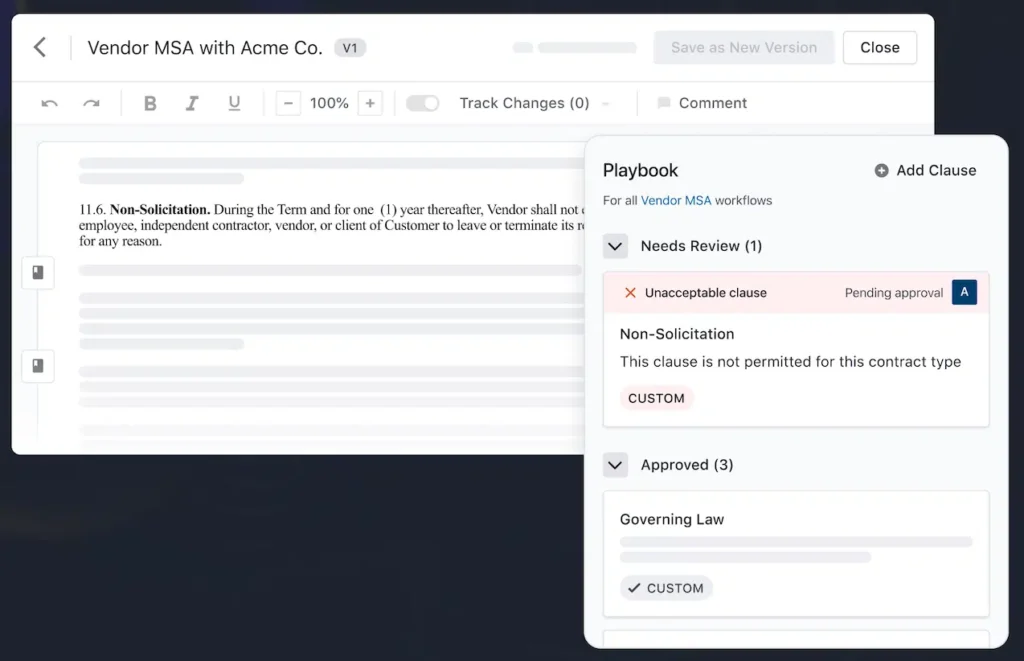
- The AI identifies clauses and compares with your pre-defined clauses to identify any risk or unknown clauses that need your attention
- You confirm, change, edit, or deny the suggestions that the AI offers
Instead of manually reading through every line until your eyes cross, contract review software with AI uses contextual analysis to go beyond a simple search function. The AI can find elements like dates and clauses, and understand how they relate to the contract and the boundaries you establish.
What can contract review AI do?
Do legal professionals really trust AI with their contracts? Generally, yes, but with the understanding that it’s a tool for them to use, not a replacement for their expertise.
You can use contract review AI on any contract type within any role, but let’s be real—it’s most valuable for those repetitive and routine contracts that eat up your day. Think NDAs, basic service agreements, and standard employment contracts.
- Approving, modifying, swapping, or deleting clauses within the contract
- Quickly escalating a question or clause to another team member
5 ways contract review AI can transform your legal department
Let’s consider a quick scenario to put this into perspective. With AI, you can upload, review, modify, and send a new contract version out for approval in minutes. Now multiply that time savings by the number of contracts your team reviews in a year. You’re looking at hours—maybe even days—of tedious work eliminated.
Here’s why AI contract review is changing how legal teams operate:
Dedicate more time and attention to high-impact tasks
Would your time be better spent on long-term strategy and goal setting or reviewing your 10th NDA of the week? Contract review AI can result in a sixfold increase in the number of contracts you review, which means you can devote your time to high-impact contractual risk review tasks. And according to our most recent State of AI in Legal report, 57% of legal teams report that it also frees up time to work on analysis and more strategic work.
Simplify legal team onboarding and ensure consistency
A contract veteran that knows your review checklist like the back of their hand can make quick work. What if someone new needs to review contracts, though? Contract review AI eliminates a new hire’s learning curve as they learn your organization’s standard operating procedures. Handing the first pass of a contract review to AI also ensures consistent work across every contract stakeholder. No more wondering if everyone’s following the same playbook.
Work through your review queue faster to close more deals
Let’s be honest—legal teams are often seen as bottlenecks in the business process. But what if you could flip that narrative? The right tools take legal teams from cost centers to business partners. The quicker your contract review is, the less of a bottleneck your team becomes. The fewer contracts in your review queue, the faster sales and procurement teams can close deals or place orders.
“I would say 80% of the time, it got us to where we needed. Which made us move a lot faster,” says Charlene Barone, former Director of Legal Operations & Strategy at Orangetheory, of implementing an AI solution.
Contract review AI features that are built directly into a CLM solution also make it easy to move contracts across stakeholders and ensure visibility. The result? Better collaboration and a stronger bottom line for your organization.
Reduce contract review human error
You’re highly talented and knowledgeable, but you’re still a human. Any time you review large amounts of information, there’s a chance you’ll miss something.
Something as simple as a tight deadline, long queue, or a Slack message that breaks your focus can interrupt your contract review. With AI assistance on your team, you can trust that you’ll accurately review every clause and maintain compliance, even in high-pressure situations.
Leverage data from every contract
Each contract is an opportunity to learn and improve. For example, do you know how much time contract review adds to the sales cycle? What about how long a redline on a non-solicitation vs. an IP indemnity clause adds to your contract lifecycle? Are there clauses you need to set expectations about proactively?
AI-powered contract review gives you visibility into the usage of each clause and its correlation with the number of back-and-forth negotiations, so you and your team can further optimize your contracting process. Plus, you’ll be able to quickly search for and find past contract details to compare, answer questions, strategize, and handle contractual obligations.
Use cases for other departments
What if you’re not on the legal team? Contract review AI can benefit people in other roles across the company.
Procurement
- Analyzing supplier agreements. AI can quickly compare terms across multiple suppliers to ensure the best deals.
- Identifying cost-saving opportunities. AI can spot areas where negotiation could lead to better pricing or terms.
- Ensuring compliance with company policies. AI can flag clauses that deviate from standard company practices.
Human Resources
- Reviewing employment contracts. AI can ensure consistency across roles and compliance with labor laws.
- Analyzing non-disclosure agreements. AI can identify potential loopholes or overly broad clauses.
- Checking compliance with labor laws. AI can flag any terms that might violate local or national regulations.
Sales
- Reviewing customer contracts. AI can quickly spot non-standard terms or potential risks.
- Identifying potential risks in sales agreements. AI can highlight clauses that might expose the company to liability.
- Ensuring consistency across different client contracts. AI can compare contracts to maintain fairness and standardization.
Finance
- Analyzing financial agreements. AI can identify key financial obligations and potential risks.
- Reviewing loan documents. AI can flag unusual terms or conditions that might be unfavorable.
- Identifying potential financial risks or obligations. AI can highlight clauses that could impact cash flow or create unexpected liabilities.
IT
- Reviewing technology licensing agreements. AI can identify unfavorable terms, usage restrictions, or compliance requirements in software and hardware contracts.
- Analyzing service level agreements (SLAs). AI can highlight performance guarantees, penalties, and support commitments to ensure adequate protection.
- Identifying security and data privacy requirements. AI can flag provisions related to data handling, breach notifications, and security standards to ensure regulatory compliance.
- Managing vendor relationships. AI can track renewal dates, termination clauses, and change management provisions across multiple technology vendors.
Quiz: test your contract AI maturity
Key considerations for using contract AI software
Using AI for contract review can be a powerful tool, but there are several key considerations that people should keep in mind:
AI is a tool, not a replacement
AI can significantly streamline and enhance contract review processes, but it should be viewed as a tool to assist human professionals, not a complete replacement. Human expertise is still essential for interpreting nuanced legal language and making judgment calls.
Training and customization are required
AI contract review systems often require training to understand an organization’s specific requirements and language. They can be customized to align with the organization’s unique needs and preferences.
Data quality matters
The accuracy and effectiveness of AI in contract review depend on the quality of the data it is trained on. Ensure that your contract data is clean, consistent, and properly labeled.
Expect regular updates
AI models and algorithms need to be regularly updated to stay effective. Laws, regulations, and contract standards can change over time, and the AI needs to adapt accordingly.
Look for transparency
Understanding how the AI system arrived at a particular conclusion or recommendation is crucial, especially in legal contexts. Look for AI solutions that offer transparency and explainability features.
Legal and ethical considerations
Be aware of legal and ethical considerations when using AI for contract review. Ensure that the AI system complies with data privacy laws and regulations, and consider ethical implications related to bias and fairness.
Security and confidentiality are crucial
Contract data is often sensitive and confidential. Ensure that the AI solution has robust security measures in place to protect the data it processes.
Integrate with existing systems
Consider how the AI contract review tool integrates with your existing contract management, document storage, and workflow systems. A seamless integration can improve efficiency.
Think about scalability
Determine whether the AI solution can scale to handle your organization’s contract volume and complexity. Some solutions may be better suited for smaller or larger enterprises.
Do a cost-benefit analysis
Evaluate the cost of implementing AI for contract review against the expected benefits in terms of time savings, accuracy, and risk mitigation. Ensure that the investment aligns with your organization’s goals.
Get user training
Users, including legal professionals and contract managers, should receive adequate training on how to use the AI system effectively. This includes understanding its capabilities and limitations.
Ensure compliance and auditing
Ensure that the AI system allows for compliance auditing and record-keeping, which can be crucial for legal and regulatory purposes.
Have a vendor selection process
Choose a reputable vendor with a track record in contract AI solutions. Research the vendor’s customer references and consider their industry expertise.
Using AI for contract review has the potential to bring significant efficiency and accuracy gains to contract management processes. However, a thoughtful and well-planned approach, along with a clear understanding of its capabilities and limitations, is essential to maximize its benefits while maintaining legal and ethical standards.
Bonus: contract review AI FAQ
How does AI assist in contract review?
AI employs natural language processing (NLP) to comprehend and analyze text in contracts. It can identify clauses, provisions, and key terms, helping to summarize, categorize, and flag potential issues or anomalies within the documents.
What are the benefits of using AI for contract review?
AI streamlines the contract review process, saving time and reducing the likelihood of human error. It can quickly scan vast amounts of text, increase consistency in analysis, and highlight crucial areas needing attention.
Can AI replace human lawyers in contract review?
AI enhances the capabilities of legal professionals but doesn’t replace them. While AI speeds up the review process and identifies patterns, human oversight is crucial for nuanced interpretations, understanding context, and making final judgments based on broader legal knowledge and business context.
Is AI capable of understanding the nuances of legal language and context?
AI has advanced significantly in understanding legal language. However, while it can recognize standard clauses and patterns, the interpretation of highly nuanced or context-specific clauses may require human expertise.
How accurate is AI in contract review?
AI can achieve high accuracy in identifying standard clauses and common language patterns. However, its accuracy may vary based on the quality of data it’s trained on and the complexity of the contracts being reviewed.
What types of contracts can AI review?
AI can review a wide range of contracts, including but not limited to sales agreements, employment contracts, non-disclosure agreements, lease agreements, and more. The adaptability of AI tools allows them to learn and review various types of contracts.
How secure is the use of AI for contract review?
Ensuring data security is a priority. Reputable AI tools use encryption, access controls, and other security measures to safeguard sensitive information within contracts. It’s essential to choose trusted and secure platforms for AI contract review.
What should I consider when implementing AI for contract review?
Consider factors such as the accuracy and reliability of the AI tool, compatibility with existing systems, data security, training required, and the need for human oversight. Additionally, understanding the limitations of AI in legal analysis is crucial.
How can I get started with AI for contract review?
Begin by researching and selecting reputable AI tools designed for contract review. Consider trials or demos to assess their suitability for your specific needs. Implement gradually, allowing for training and integration with existing workflows while ensuring oversight by legal experts.
Ironclad is not a law firm, and this post does not constitute or contain legal advice. To evaluate the accuracy, sufficiency, or reliability of the ideas and guidance reflected here, or the applicability of these materials to your business, you should consult with a licensed attorney. Use of and access to any of the resources contained within Ironclad’s site do not create an attorney-client relationship between the user and Ironclad.