
2026 Forrester Research: Why Most Enterprises Aren’t Using CLMs to Their Full Potential
We recently commissioned a study from Forrester Consulting to examine the the shifting role of contracts into intelligent, strategic assets for modern enterprise organizations. Here’s what you need to know.

Want more content like this? Sign up for our monthly newsletter.
Your CLM is more than a single piece of software. Operationalize a CLM right and you can manage uncertainty, assign accountability, and mitigate risk.
That’s because your CLM holds the link behind all of your major business decisions: Your contracts.
- When geopolitical events threaten your supply chain…
- When regulations change dramatically…
- When AI capabilities evolve what’s possible…
- When you want to know where key business opportunities are…
It’s your AI CLM that acts as a critical layer of enterprise infrastructure. An enforceable guardrail that extends beyond traditional contract repositories or pre-signature tooling.
We wanted to test the idea: Is CLM maturity defined less by analytics and more by execution? We hypothesized that the systems and processes an enterprise organization uses matters just as much, if not more, than the CLM itself. We’ve seen this firsthand in our own CLM execution at Ironclad, but is it true across other enterprises?
To find out, we partnered with Forrester to survey more than 500 CLM decision-makers across procurement, IT, legal, and finance from the United States, the United Kingdom, France, and Germany. Here’s what we found:
Contracts are the new strategy for enterprises
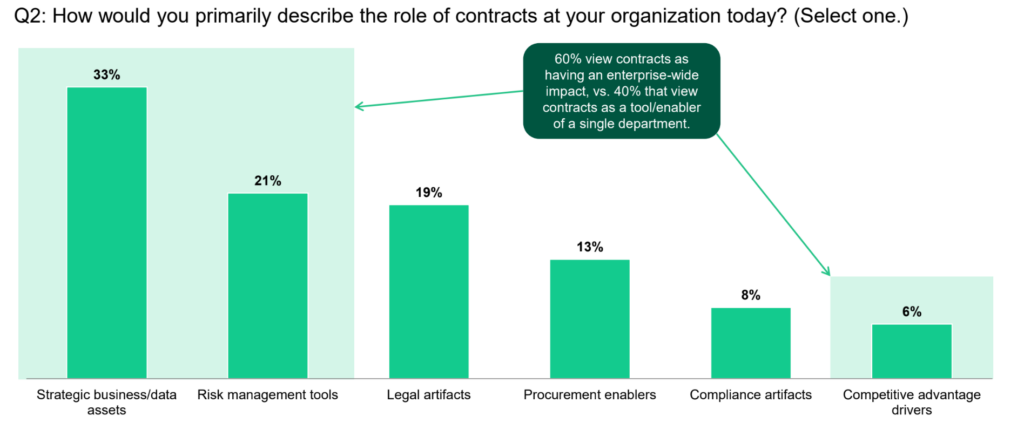
Contracts are no longer just documents that live in a shared repository, only to be pulled out come renewal time. Now, they’re perceived as strategic assets—and rightly so. When we asked about the role contracts play in business operations, 60% of respondents viewed contracts as having an enterprise-wide impact via strategy, risk management, and competitive advantage.
Enterprises increasingly rely on contracting to drive operational efficiency, cost optimization, compliance, and digital transformation. After all, your contracts are the foundation of your business. They serve as a record of your business transactions and hold key information about your overall performance.
That’s why ownership of contracting success has expanded in many cases beyond legal, to include procurement, operations, and business stakeholders—making contracts an enterprise-wide concern.
…but most enterprises aren’t using CLMs to their full potential
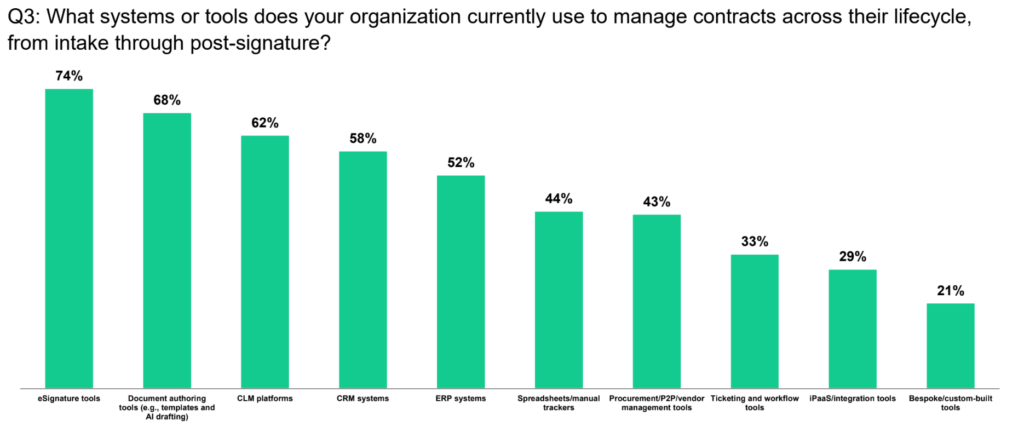
CLM adoption is relatively widespread for our respondents, with two-thirds of respondents using a CLM (62%) and an even higher majority using eSignature tools (74%) and document authoring tools (68%).
However, only 43% of our respondents are actually satisfied with their CLM platform.
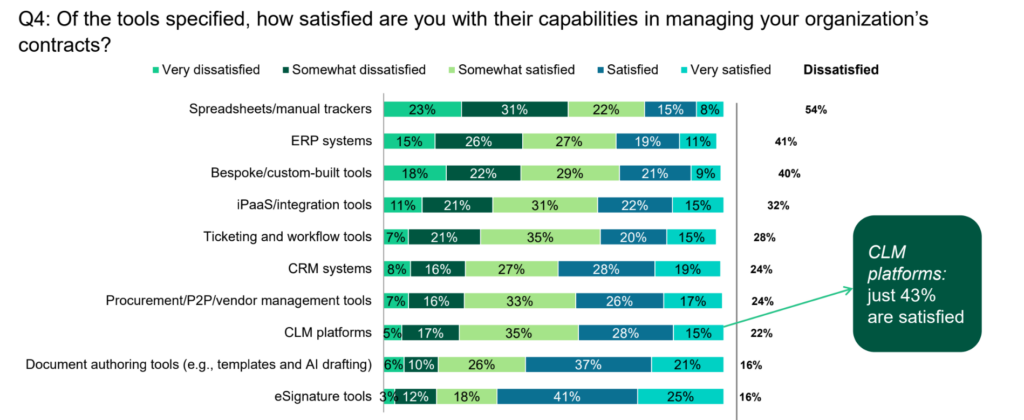
As we dug further into the data, we realized that’s because most of our respondents may not be using tools like contract lifecycle management systems (CLMs) to their full potential. Only 40% of our respondents operated on a single CLM platform, with 36% using multiple CLM solutions, giving them a fragmented, disconnected experience across the business.
In addition, 76% of respondents told us that their contract data is only somewhat integrated with their other operational systems like CRMs, making it difficult to get a complete picture of their actual business opportunities. Only 23% of our respondents are running a fully integrated CLM—so no wonder the majority aren’t seeing results.
Visibility remains the biggest challenge for enterprise contract management
Many CLM programs remain optimized for contract creation rather than ongoing execution and performance management. Without a single, connected system, enterprises are missing out on the greatest benefit a CLM can offer: Visibility into their contracts.
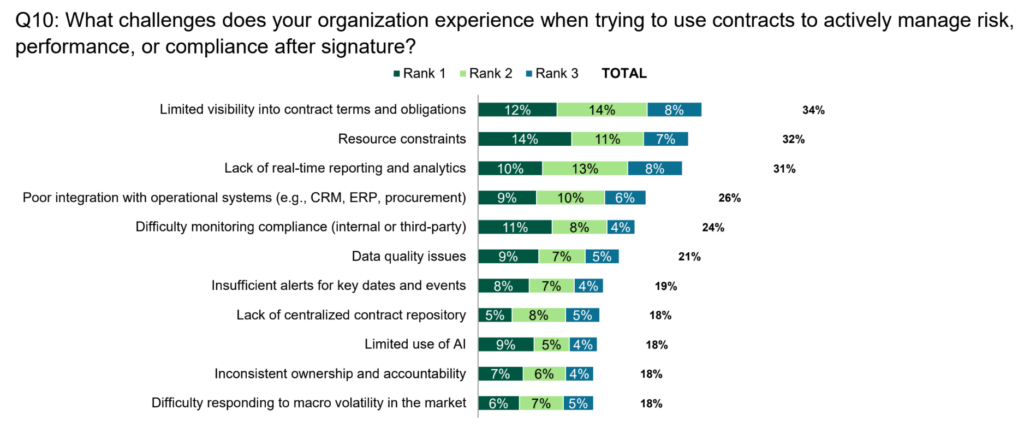
As legal, procurement, and IT teams are asked to do more with less, the primary challenge is no longer creating a digital record of a contract, but executing, monitoring, and operationalizing them so they become useful and strategic for the business.
Without real-time insight into contract performance, obligations, and risk exposure, your CLM remains a glorified contract repository. Great for making sure your contracts are in one place…but it’s not going to help you assess your supplier exposure or help you find negotiation patterns in your performance. (Both things an AI-enabled, fully connected CLM can do.)
Where that is most obvious is in post-signature workflows. The key to realizing the actual value of a CLM is making this part of the contract lifecycle work. This includes:
- Obligation tracking: What are your current obligations to your business partners, and are you meeting them? Similarly, are your suppliers delivering what they said they would? You can’t know for sure without going through every single contract.
- Renewal management: When is the next contract up for renewal, and should it be re-negotiated? A missed auto-renewal can lock your business into a high spend for years.
- Milestone monitoring: How quickly are you turning contracts around? Legal and procurement have a reputation for “holding the business back.” But does the data really say that?
- Operational integration: Can business stakeholders also get visibility into their contracts and signatures so they can better assess risks and determine next steps? This is especially important for fast-moving organizations like sales teams.
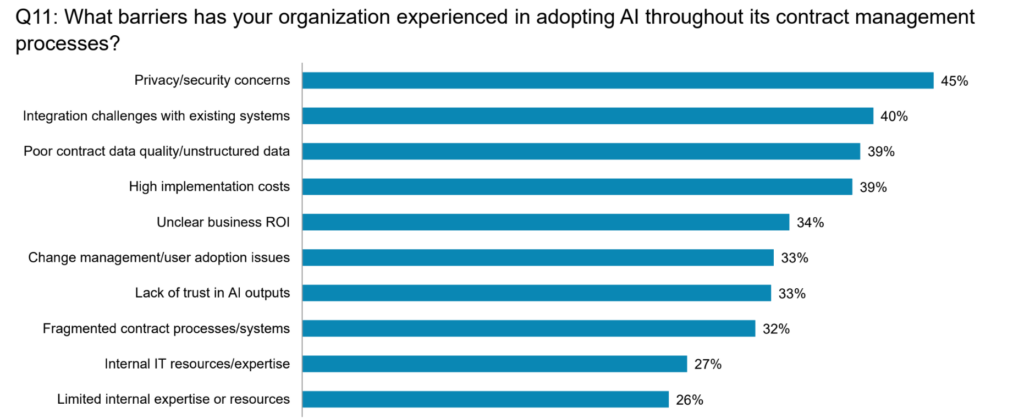
Artificial intelligence is primed to fix these issues, but many organizations still struggle with barriers to adoption. Interestingly, these barriers focus primarily on execution in a large organization—issues like integrating with existing systems (40%), low data quality (39%), and high implementation costs (39%).
The next generation of CLMs go from system of record to system of intelligence
AI can solve your visibility issues, but it needs to be done on a systemic level that continuously connects contracts, operational data, and business processes to drive better decisions, reduce risk, and improve outcomes.
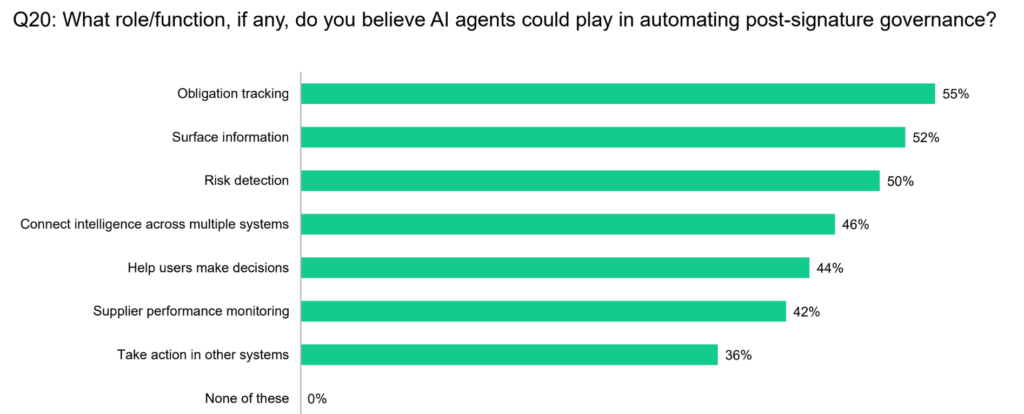
AI takes CLMs that function as contract repositories and turns them into useful, connected systems that work with your existing processes to unlock real business insights. Our respondents were most excited about obligation tracking (55%), surfacing relevant information about their contracts (52%) and risk detection (50%). 74% believe continuous alignment between contract and operational performance data would create significant business value. (We agree!)
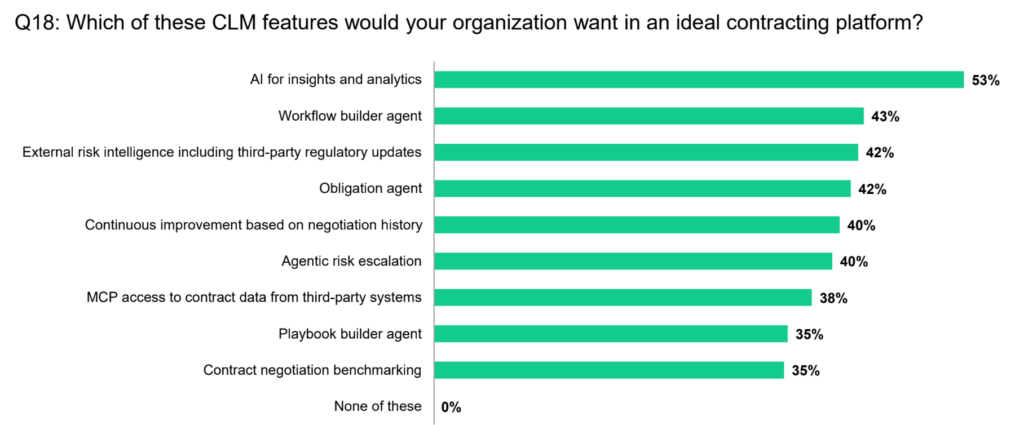
What does that look like in practice? Instead of a standalone AI tool, our respondents preferred platform-native AI with embedded productivity experiences and API-driven integrations. Nearly 50% preferred these kinds of prebuilt integrations that ensured their systems “talk” to one another, with AI as the layer that makes it useful.
To actually solve the visibility challenge, however, you need to go back a step and take a look at your data. Where are your contracts currently stored, and are they usable?
Take, for example, a common contract pipeline between sales and legal. Sales uses a CPQ tool to create the product or pricing schedule, which in turn determines what contracts and clauses need to be included in a given contract. Without connected systems, that means a lot of manual copying and pasting for each line item and hoping you’re not missing anything.
AI alone can’t fix a broken workflow like this. But if you’ve got AI embedded into a connected workflow between your CPQ, CRM, and CLM…this becomes 1000x easier.
For artificial intelligence to be successful in your organization, you need three elements:
- A strong workflow design: A cross-functional legal flow that maps to how your team actually gets work done
- High data quality: A well-trained model that has access to real legal data, not just what’s on the Internet
- System context: Additional inputs from your specific organization so AI understands what your protocols, stances, and contract/negotiation history looks like so it can give you outputs that match what matters for your team, not just every legal team
AI is only as successful as the systems it lives in
After poring over hundreds of data points from Forrester’s survey, the answer is clear: Your AI tools are only as successful as the system it lives in.
That means to make your CLM actually work for your business, you need to build a connected workflow between your teams, transforming a fragmented contract ecosystem into an integrated, AI-enabled source of insight and action.
AI can solve much of the visibility and analytics issues our respondents struggle with today. More than half of organizations in our survey have adopted AI-powered contracting capabilities, and Forrester projects strong expected growth in AI-driven contract analysis, search, and dynamic contract management over the next two years.
See how a connected CLM can change everything about your contract management by requesting a demo today.
Ironclad is not a law firm, and this post does not constitute or contain legal advice. To evaluate the accuracy, sufficiency, or reliability of the ideas and guidance reflected here, or the applicability of these materials to your business, you should consult with a licensed attorney.