



Process Before Tech: Why the Fundamentals Matter for Procurement Teams

A new piece of technology won’t solve your organization’s problems.
(Yes, we know we’re a tech company. 🙃)
But technology can’t fix people that won’t work together. Or when a process requires so many checked boxes or forms in triplicate that no one follows it.
It’s more important than ever for procurement teams to nail the fundamentals of their craft. To set procurement teams up for success, we sat down for an in-depth interview with Tom Mills, Procurement Protagonist and voice behind the newsletter Procure Bites.
When it comes to something shiny and new, “I think ego gets in the way,” Tom explains. “The number one thing I’ve seen people get wrong is underestimating the importance of having the right foundation in place. I think sometimes you can almost think tech is the only solution, when tech is part of the solution. I always recommend addressing the fundamentals first.”
Tom recommends paying attention to your people and your processes before adding any new tools for your procurement organization. Here’s how:
People: Prioritizing internal and supplier relationships
Even the best tools can’t fix teams that won’t work together.
The best procurement tools facilitate the heart of what procurement is about: Relationships. It’s about delivering the best value you can from a strategic partnership—and before you can add tech to that, the people-to-people part has to work, too.
We often talk about metrics that matter in procurement, like approval times per function, majority spend suppliers, RFP turnaround, or your overall return on your investment. Behind those metrics, though, you’ll find more insights into how the organization is running by getting in touch with your feelings.
Start with your supplier relationships
“When I first join an organization, I always start with my suppliers,” Tom explains. “I want to talk with them about what’s working, look at the KPIs, evaluate the SLAs, and make sure we’re both ready to develop a plan together.”
There’s a lot of touchy-feely aspect to this part of the job that gets missed in the reams of data you have access to. Sometimes, Tom says, it comes down to how the relationship feels between you and your suppliers to understand whether or not it’s really working, regardless of what your contracts or KPIs say.
When you speak with your suppliers, ask them for a gut-check:
- What’s their perception of your business? What you provide, but also what your value props and benefits are as a partner?
- How do they feel the relationship is working? Is it easy to work together, or not?
- What is their assessment of your larger procurement team? Not just your 1:1 relationship, but how they interact with the rest of your teammates?
Internal cross-functional collaboration isn’t just a governance model
Then, take those same questions and turn them around to your team. Do the two assessments match up? This can help you get to the people part behind the processes and performance to figure out what’s not working. “It’s definitely subjective,” Tom acquiesces. “Human touch points are what give you a real indication of how procurement is embedded in the process, and whether or not your team is living up to their promise of adding value.”
To get buy-in from stakeholders at the start of a buying decision, Tom opts for a carrot vs. stick approach.
“We’ve got to flip the narrative when we’re speaking to stakeholders so that everything isn’t about policy and governance,” he says. “The more you can show that you are there to facilitate the business getting what it needs, the better your interactions will go.”
Even in situations where a stakeholder should have submitted this form or gone through that process, starting a conversation with everything a stakeholder did wrong is a surefire way to make sure they never want to work with your team again. (Leaving you with an even bigger problem than before. “I find that people respond far more effectively to positive reinforcement. Reframing your discussions around how you can help work with them when you’re brought in earlier, or how you help teams get big buying decisions done, rather than an emphasis on the rules, so to speak, gives them a better reason to engage with you in the future.”
No matter how great the data looks on paper, without those conversations, you won’t be able to understand the full process—and the people behind that process—to determine what kind of technology will best suit your team or fix the problems they’re experiencing, whether it’s a lack of visibility into the supply chain, an inefficient vendor onboarding process, or a wider organizational issue.
Processes: Map out the entire buying process first
You can’t use technology to fix what’s really a process problem.
Take supplier data. You can have the best piece of software in the world, but if your intake requests live in five disparate systems—or your contracts aren’t digitized at all—it’s not going to actually deliver the insights you need.
Tom explains that this kind of cart-before-the-horse technology implementation happens because teams can get too invested in what’s hot instead of what’s needed. “I think ego really gets in the way,” he says. “What happens is that people start thinking, ‘I want to be best-in-class, and I want what my competitor has, but when you strip ego from your decision-making, you realize you have to start from the beginning. I always advocate for good technology, but if you don’t marry that with stakeholder engagement and communication with the right people, then you’re only delivering part of the solution.”
That means evaluating your entire buying process as an organization. Not just your ideal state, but what’s actually happening.
Identify your team’s pain points and how technology can solve it
Tom recommends starting with your team’s pain points. “Where are the pain points in our organization? Do you have low visibility into SLAS? Do your RFPs take too long to assemble? And then how can we use technology to help solve those? If you don’t know what your team is struggling with, then you can’t find the right solution.”
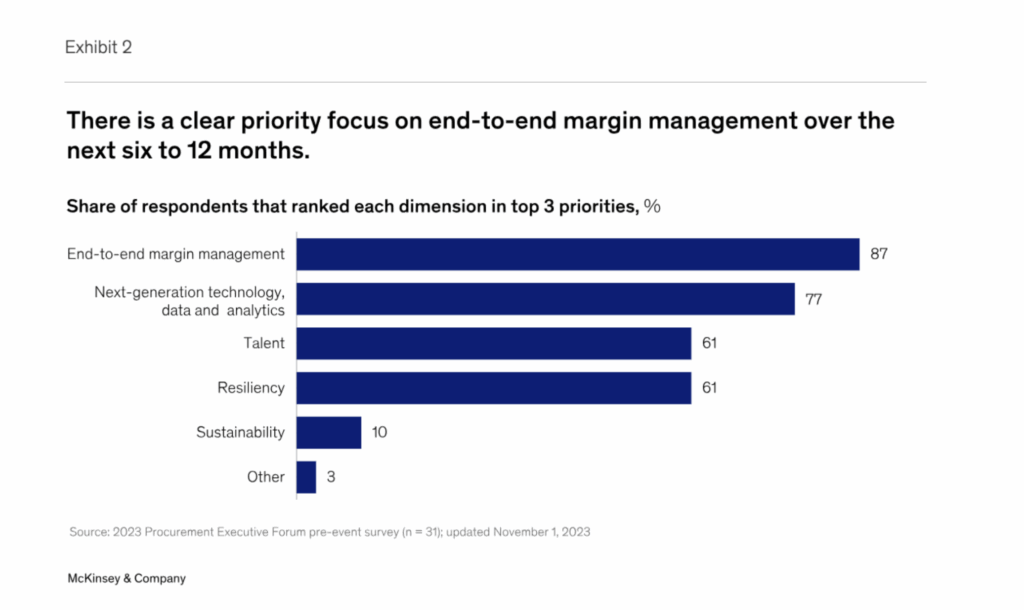
Looking at the average team’s priorities, end-to-end margin management comes up as one of the biggest pain points, according to McKinsey. Monitoring and optimizing a company’s profitability across the entire supply chain requires visibility into every aspect of a company’s operations, and often, procurement gets left out. (This is followed by the right data and analytics, hiring the right people, and supply chain resiliency and sustainability.)
There’s a lot of nuance even within a topic like margins. You’ll need to dig deeper to understand what that means for your specific organization. Is it that your team doesn’t have visibility into finance, sales, or marketing? Or that those teams bulldoze ahead on their buying decisions without consulting procurement until the last minute?
It’s the latter that Tom finds most often when he talks to procurement professionals.
When do stakeholders engage procurement in the buying process?
Part of identifying pain points is understanding the entire procurement process from start to finish. Overlay the current process against the ideal one for your team to determine where your biggest gaps are.
For Tom, it’s almost always an issue of when stakeholders bring procurement in to the buying decision. “One of the biggest challenges for procurement professionals in any organization is getting engagement at the very start of the decision to buy,” he says. “You may have a strong governance framework, but if it’s not clear to stakeholders when and where they should be using it, or how to follow the process, it’s not going to happen. You need a very simple process flow for stakeholders to follow.”
A simple flow might include the following steps:
- Identify the need for a good or service → Submit a purchase request to the procurement team.
- Procurement + stakeholder works together to source and select a vendor.
- Once a vendor is selected, the procurement team negotiates the deal and signs the PO.
- Delivery or implementation takes place, and the procurement team handles the payment process and recordkeeping for the future.
- Stakeholder reports back on implementation, including adoption and reporting on success using the new good/service as a team.
But for this to work, your stakeholders have to actually follow the process—which starts with communicating with procurement. “Often what I see happen is that procurement gets called in at the very end when there’s already a contract in play, which skips over the first few steps of the ideal process entirely,” says Tom. “When as we all know as procurement professionals that the value we bring is much earlier in the process, in terms of vendor selection and negotiation.”
Master your people and processes first, before adding any new technology to your org
So, how do you evaluate a new piece of technology so it works with your team’s needs, instead of adding another screen to look at or a box to check?
“You’ve got to make a clear value assessment of the maturity of your procurement team and the maturity of your organization first, and then you can evaluate a piece of technology based on whether or not it will solve those issues,” Tom advises.
Procurement’s role is to make sure each area of the business gets what it needs to perform its function, for the best value. When evaluating a new tool, divide up the features and benefits by “essentials” vs. “nice-to-haves.” Then, ask yourself:
- Does the tool I’m buying actually address the pain points that my team talk about? What about the ones my suppliers talk about?
- How will this tool actually fit into the day-to-day life of my team today?
- Can my team grow into the more advanced features that this tool offers?
Don’t get distracted by what a tool could do for your team. Focus instead on what you need right now. Says Tom, “It’s important to evaluate any solution by what your team needs now, and what they need in the future. To get adoption from your team, you need to fix their current problems first.”
Ultimately, the value of a CLM for your procurement team comes down to whether you have the basics in place. Great supplier relationships are built on a strong understanding of the facts of your agreements—and the people who made them.
For more procurement insights from Tom Mills, check out the rest of his conversations with Ironclad:
- How to Maximize Your First 90 Days in a New Procurement Org
- The 3 Biggest Challenges Procurement Professionals Faced in 2025—and How to Address Them in 2026
- Why Procurement Professionals Get Burnout—And What to Do About It
Ironclad is not a law firm, and this post does not constitute or contain legal advice. To evaluate the accuracy, sufficiency, or reliability of the ideas and guidance reflected here, or the applicability of these materials to your business, you should consult with a licensed attorney.


