



The 3 Biggest Challenges Procurement Professionals Faced in 2025—and How to Address Them in 2026
Procurement teams face mounting pressure to deliver more with less. Learn how to shift from tactical to strategic operations and overcome 2026’s key challenges.

Receive the latest updates on growth and AI workflows in your inbox every week
When we asked Tom Mills of Procure Bites how he would describe working in procurement right now, the first word that came to mind was: Pressure.
“In procurement, we’ve been faced with so much pressure, from geopolitical issues to technological change,” he says. “I know plenty of procurement teams who are struggling because they’re asked to do more with less, and because the business is saying, ‘Do your job, but do it even faster and even better, and we’re not going to give you any more people to get it done.’”
It’s a challenging time across the business, and procurement is feeling it.
We wanted to get to the heart of what procurement professionals need as the industry changes. We’re at an inflection point with procurement, and the teams that successfully address these challenges are the ones that will build a long-term, sustainable procurement practice in terms of cost, people, and technology. In this post, we’ll cover the key challenges facing procurement professionals today—and what to focus on to solve them in the future:
Procurement teams are under pressure to deliver more value with less
This existential crisis comes just as much from external pressure as it does from the organization itself. The team is under pressure to optimize spend, coverage, and compliance, first and foremost. But behind all that is a misunderstanding from elsewhere in the organization: What is the value of procurement?
Geopolitical instability creates a fragile supply chain
What brings this question to the forefront is that procurement teams are the first to see and notice broader economic issues and trends. There’s nothing an individual in procurement can do about a conflict on the other side of the world making it impossible for a specific widget to get shipped on time. Yet that’s the person who gets blamed for it.
“The pressure here is that we’re becoming more and more dependent on certain countries for our supply chain, and that creates a sense of fragility,” explains Tom. “That means we have less options, which means when something goes wrong, whether that’s politically, economically, or even the weather, that can expose our targets and have a real impact on the business.”
Take electric vehicles, for example. If a company is looking to replace their current fleet with electric vehicles by 2030, procurement’s job is to help source those vehicles. But if you dig deeper into each component of an EV, you’ll find that many of the raw materials come from one country: China. When an executive asks, “Where are we on our fleet replacement goals?” they’re probably not looking for a lesson on where and how cars are made. Yet that’s the reason you may be lagging behind in your target, and it has nothing to do with you.
That, coupled with a volatile political climate overall—there are over 150 armed conflicts today, the most ongoing globally since 1945—makes for a challenging to find reasonable options for basic aspects of your supply chain.
Trade policy and inflation increase cost and reduce options
Ask any procurement professional about what their value is in an organization and they’ll point to significant cost savings. But that’s getting more difficult to achieve, according to Tom.
“There are very real consequences with supply becoming more expensive,” he adds. “And when trade breaks down between countries, it sends out a ripple effect across the entire supply chain. Our role in procurement is to source effectively, have options, and drive competitive pricing, and the current economic landscape really limits that capability. It may just take one little thing to tip the balance where the business could really be deeply impacted.”
Fewer options already imperil your supply chain, but add trade policy, inflation, and a general sense of unpredictability and you’ve also got major costs to deal with that didn’t exist before. It’s one thing to see this in the grocery store—and another to manage it as a business.
AI promises solutions, but organizations lag behind in implementation
To release some of this pressure, procurement teams are turning to artificial intelligence solutions, which promise to bring efficiency and time-savings to their day-to-day lives. While that is absolutely true, there’s still a startup cost to implementing any new piece of technology—and most teams are still in the early stages of implementing various forms of AI into their procurement workflow.
“AI has been positioned as the solution, but teams are still learning what that looks like,” says Tom. “We’re only just at the beginning of what AI can do for procurement teams. The main pain points for procurement are still there, and teams will need to move faster to keep up.”
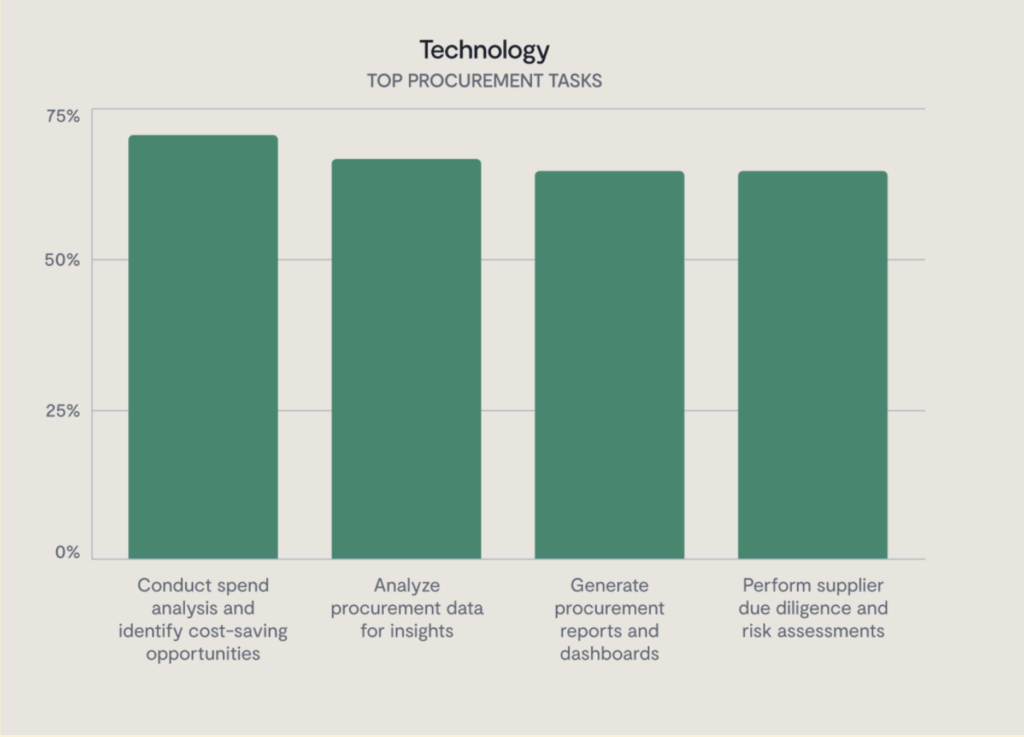
Adding AI into your procurement workflow can have tremendous benefits—across procurement teams we surveyed for in our 2025 State of AI in Procurement report, the average benefit score is 8/10. Common AI use cases include generating reports and dashboards (63%), drafting and defining technical requirements (63%), and data analysis (62%). But if your organization hasn’t started looking at it as an option, you’re not alone. When we asked procurement professionals about their AI adoption, we found that the adoption rate varied up to 30 points by industry, with procurement teams for technology companies at the highest rate of adoption (89%) and retail and healthcare at the lowest (65% and 68%, respectively.)
Taken together, all of these make stakeholder engagement even more difficult
One of the consequences of AI adoption across the organization is that it democratizes access to data that typically only procurement professionals could access. Now, more teams can use their contracts more effectively to find opportunities for cost-savings, re-negotiation, or performance—putting even more pressure on procurement to be a driver of the procurement process, instead of a last-minute addition to “check the box.”
Tom feels this the most, of any of the pressures on this list. “Stakeholder engagement is still a challenge for many procurement teams, just to actually be involved at the right time so they can show where they add value. Stakeholders are becoming increasingly time-pressured, busy, and just want to get on and do it themselves, which creates a real friction within the organization,” he says. “It’s impossible to do more with less if you’re not at the table in the first place.”
The future of procurement requires thinking differently
But it’s not all doom and gloom. These are very real pressures procurement professionals face on a daily basis, but Tom hopes this is an opportunity for organizations to think differently about the value procurement offers.
“We talk a lot about trying to get a seat at the table, but in reality, it’s how we act, and how we are that’s going to influence our ability to drive impact,” he says.
Now, more than ever, is when teams need to be proactive and strategic about their role. It’s time for procurement pros to push back on traditional procurement tasks:
Measure success not in savings but in total cost of ownership (TCO)
First, Tom recommends talking about more than cost-savings when you’re looking at success.
“Traditional targets are all about savings metrics. But what happens with that is you’ll deliver a report that you saved $10 million this year, and your CFO turns around and says, ‘Great. Next year I want you to deliver $12 million in savings.’ But that completely misses the point. It drives the wrong behavior that focuses on short-term impact, and it also ignores inflation and other economic realities.”
Instead, he advises focusing on business impact, in addition to your cost-savings:
- How did your team drive revenue?
- How did you perform against your Environmental, Social, and Governance (ESG) targets?
- How did your team mitigate risk?
Then, it’s also up to procurement teams to have open discussions about the economic pressures on the supply chain. Other departments by nature just aren’t thinking about these issues, and while they may understand it as a consumer, you’ll need to start the conversation on inflationary pressure, market rates, and how to build a plan that addresses it head on.
“Teams need to really be evaluating the total cost of ownership of any of their purchases,” Tom advises. “Not just the short-term impact, but the long-term costs of maintenance, training, and risk, and what we’re doing with the business to mitigate those costs as well.”
A new focus on cybersecurity
Procurement doesn’t usually take cybersecurity into account as that’s IT’s purview. But information services is now one of the biggest risks organizations take on when they partner with a supplier, making it a key priority for procurement teams in the future. “Typical category management, where you segment into supply chain, HR, marketing, and so on is dead,” Tom admits. “Technology underpins all of it, and with that comes a heightened regulational, operational, and data privacy risk.”
Adding security positioning to your due diligence process is a must,” says Tom. “We can no longer outsource that. It needs to be a key element to make sure the checks and balances are in place and that we’re making the right decision with our partnerships.”
As you’re evaluating new suppliers, ask them for documentation and evidence around their compliance with:
- Data privacy laws like GDPR and DORA
- Data security protocols like ISO 27001 and SOC2
- Overall security posture to learn how they respond to cyber events and what their crisis plan is for the future
This isn’t just procurement’s role by any means, but the more you can collaborate with your IT team to evaluate a potential partner, the more you can mitigate risk.
Soft skills matter more with the democratization of data
What will set individuals up for success is not necessarily their adoption of new technology or their analysis skills, but how they interact as people. “Procurement has traditionally been a specialist function, with specialist expertise, but as we look into the future, technology is going to give other teams the insights and data,” Tom predicts. “It’s up to us as procurement to evolve and find our differentiator, to answer the question of why someone would want to speak to our team instead of just asking ChatGPT.”
That’s where soft skills really matter. To meet future demand for procurement, you need to think about upskilling not just with new technology or techniques but honing your:
- Communication skills. Effective communication is the foundation of relationship-building, and that will be more important than ever with AI automating much of the mundane back-and-forth.
- Emotional intelligence. Managing suppliers and internal stakeholders requires the ability to read between the lines. What’s really going on with someone when they come to you in a rush? How can you make them feel supported and heard, in addition to delivering the data they need?
- Collaboration. How you work together as a team matters even more when you’re trying to do more with less.
Adds Tom, “We’re no longer people who can just sit behind data and spreadsheet processing. Procurement needs to be a function that is actually driving strategic business decisions, having hard conversations, and bringing the wisdom and judgment that comes from years of experience. AI can’t replace that.”
Procurement teams need to transform from tactical, service-based organizations to strategic, proactive functions
More than anything, what will set procurement organizations up for success is moving from responsive to proactive. “I think there are many procurement teams that function more as a purchasing process, and that’s exactly what will become so automated and easy that you’ll start to question the role of procurement at all,” Tom says. “The teams that make it clear to their broader organization that they’re a strategic partner that drives impactful decision-making and revenue, that’s what’s going to make a difference.”
| Tactical Team | Strategic Team |
| Responds to what the business requests Primarily spends time processing purchase orders and other requests Executes strategy of other business units Called in at the last minute in the process | Proactively finds opportunities for business to capitalize on Challenges the business on why we’re purchasing something, and wants to understand the thinking behind it Actively manages suppliers, including re-negotiation and renewal Has a seat at the table as valued member of the team |
Says Tom, “If we think about all of the challenges facing procurement professionals today, from their supply chain to inflation to AI, what businesses really need are strong, influential procurement professionals that can lead the business to make the right decisions.”
For more procurement insights from Tom Mills, check out the rest of his conversations with Ironclad:
- Process Before Tech: Why the Fundamentals Matter for Procurement Teams
- How to Maximize Your First 90 Days in a New Procurement Org
Ironclad is not a law firm, and this post does not constitute or contain legal advice. To evaluate the accuracy, sufficiency, or reliability of the ideas and guidance reflected here, or the applicability of these materials to your business, you should consult with a licensed attorney.

