



The Clauses That Crumble Under Supply Chain Volatility (and How to Fix Them)
Here’s how to identify the contract clauses that are costing your manufacturing organization the most and what to do about them before the next disruption hits.

Want more content like this? Sign up for our monthly newsletter.
Your contracts show pressure points in your supply chain before you even realize it.
Manufacturing companies operate today in a frantic race for their business administration to catch up to their market obligations. You’ve seen it in real negotiations. Trade policy switches again just as you’ve nailed down the last piece of a contract. Geopolitical tension upends a key shipping route. A fragile supply chain breaks down even further with the latest natural disaster. These pressures drive costs up, up, up, and there’s only so much that you can pass along to the consumer.
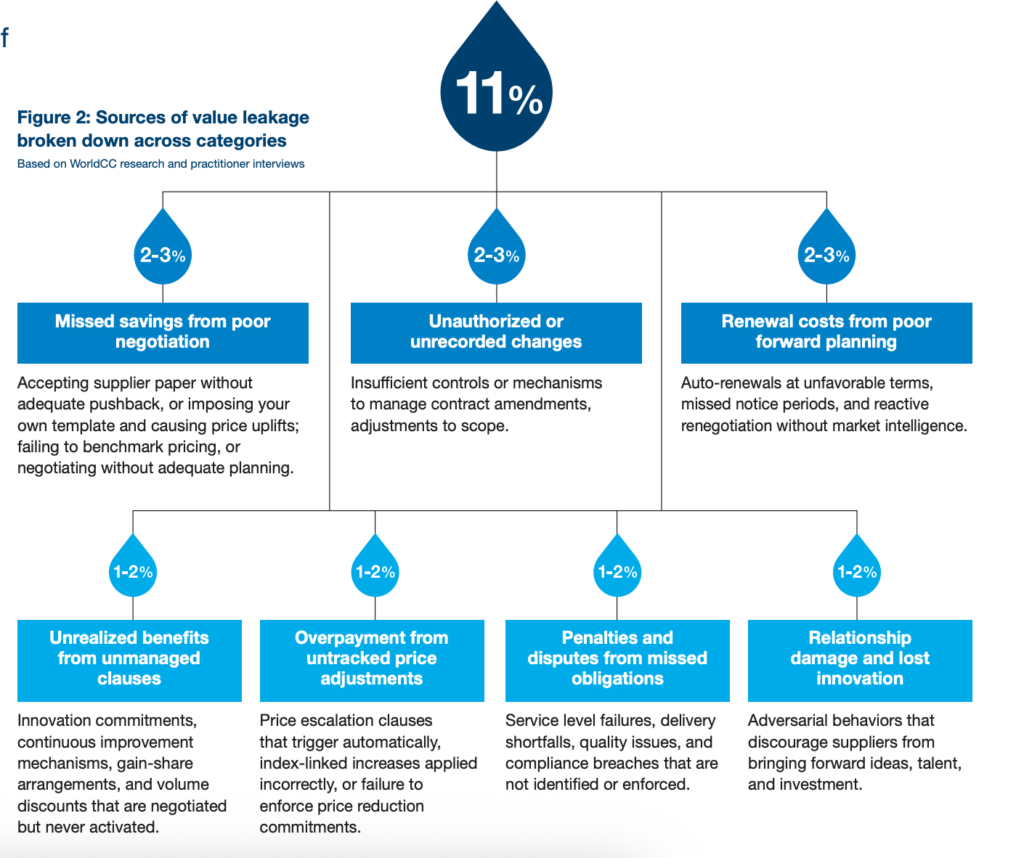
Your contracts can either give you the flexibility your organization needs to pivot in an uncertain environment like this…or trap you into agreements that are costing significant value leakage over time. In World Commerce & Contracting’s most recent report, organizations lose an average of 11% of their contract value on average. when you look at all industries on average. In this post, we’ll talk through why that is—and the specific clauses that you can fix to prevent those leaks in the future.
The missed opportunities in a typical manufacturing contracting process
The average contracting process in procurement, according to our research, takes 23 days to execute, with two-thirds involving legal at some point. 77% of those contracts also use third-party paper.
Manufacturing Sub-Category Benchmarks for Procurement
| Category | Third-Party Paper | Legal Involvement | Days to Execute |
| Industrial Manufacturing | 88% | 41% | 40 |
| Agriculture | 83% | 67% | 20 |
| Hardware and Semiconductors | 96% | 66% | 14 |
Industrial manufacturing has the slowest process. But is a faster process better if you take on significantly more risk, like hardware and semiconductors?
For most organizations, what creates this friction is a combination of legacy processes and a risk-averse culture that creates so many checkpoints it’s impossible to move quickly. While 93% of manufacturing leaders say data improves decision-making, 78% decision makers say a substantial time is spent looking for information across systems.
Flexibility is the key to adapting to this changing macroeconomic environment. That means more flexibility built into your contracts (more on that in a minute) but also building a more flexible internal process that empowers your team to be nimble without compromising your risk profile.
5 clauses that crumble under pressure (and how to fix them)
Where does contract leakage come from?
Source: 2026 Procurement Value Gap Report
Contract leakage can occur naturally from market pressures, but more often, it’s the result of specific choices in your contracts that seem like they’re checking the right boxes—offloading risk to the supplier, for example, or an airtight pricing structure—when all this does is make your contracts even more inflexible. You probably have these clauses lurking in many of your contracts:
Pricing and cost escalation
Your prices aren’t static, so don’t make it seem like they are from your contracts. Price escalation clauses that trigger automatically, without a connection to market forces, can lead to overpayment. On the flip side, failure to enforce price reduction commitments leave savings on the table.
Key elements to track include:
- Price adjustment triggers: What events activate price changes? Are triggers objective (5% increase in raw materials) or subjective (‘significant cost increase’)?
- Benchmarking rights: Can the buyer benchmark pricing against market rates? What happens if pricing is found to be uncompetitive?
- Most-favored-customer clauses: Does the supplier commit to offering terms at least as favorable as those offered to other customers? Are you able to monitor this provision and are there valid comparisons?
- Volume discounts and rebates: What thresholds trigger discounts? How are rebates calculated and claimed?
To fix it: Instead of fixed-price contracts, tie price changes to objective, verifiable indices like the consumer price index (CPI) with a clear base date, caps and floors on adjustments. Define up front how tariff changes will be handled, and require suppliers to provide cost breakdowns that justify any significant price adjustment claim with evidence.
Renewal and termination triggers
Renewal events can be huge leverage moments, but many teams miss these key negotiation windows. With so much changing in the marketplace in any given year, is this a supply agreement that’s still serving your manufacturing process?
Key elements to track include:
- Auto-renewal dates: When do contracts automatically renew? What is the notice period to prevent renewal (typically 30-90 days, sometimes 180 days for enterprise agreements)?
- Termination for convenience: Can the contract be terminated without cause? What are the notice requirements and costs?
- Exit costs and transition assistance: What are the costs of exiting? Is the supplier obligated to assist with transition?
- Price escalation at renewal: What pricing applies if the contract renews? Are there caps on renewal price increases?
How to fix it: The ability to exit cleanly protects long-term leverage. To do this, make sure your contracts define what happens to assets, equipment, and intellectual property created during the contract. For critical services, include the right to step in (or appoint a third party) if the supplier fails to perform.
Delivery and penalty structures
What happens when a supplier fails to meet their obligations? Without tracking mechanisms to specify this in your contracts, there isn’t much you can do.
Key elements to track:
- Key Performance Indicators (KPIs): Are KPIs outcome-based or activity-based? Do they evolve as the relationship matures?
- Liquidated damages: What are the financial consequences of underperformance? Are they calibrated to incentivize behavior or simply punish? Might it be more effective to operate with performance incentives?
- Cure periods: How long does the supplier have to remedy a breach before consequences apply?
- Continuous improvement commitments: Are there year-on-year improvement targets? How are they measured and enforced?
To fix it: Make sure your service-level agreements (SLAs) contain specific, measurable outcomes and consequences for your agreement. You should outline metrics, measurements, how those metrics will be communicated between parties, and what the consequences are of a breach.
IP and tooling ownership
With so much focus on price and risk in your agreements, it can be easy to forget the kinds of value-creation clauses that add depth to a given partnership.
Key elements to track include:
- Innovation commitments: Has the supplier committed to bringing forward new ideas, technologies, or process improvements?
- Gain-share arrangements: Are savings or efficiency gains shared between the parties? How are they calculated and distributed?
- Exclusivity benefits: If the buyer has committed volume or exclusivity, what benefits flow in return?
- Joint development rights: If the parties collaborate on new products or services, how is Intellectual Property (IP) ownership and commercialization handled?
How to fix it: First, if you’re not already negotiating some of these elements into your agreements, it may be time to consider what could be most beneficial to you. This depends on your sub-industry of manufacturing, of course. From there, make sure you’re putting a governance structure in place that allows you to monitor whether these clauses are being met. Otherwise, it’s just lost time, effort, and goodwill from the negotiating table.
Force majeure and risk allocation
Understanding who bears risk and whether risk is actually managed is critical. Adding risk clauses into your contracts doesn’t necessarily eliminate the risk, but instead transfers that cost to the supplier—which may come at a price to you.
Key elements to track include:
- Limitation of liability: What are the caps on liability? Are there carve-outs for specific risks (data breach,IP infringement, gross negligence)?
- Indemnification: What risks does each party indemnify the other against? Are indemnities mutual or one-sided?
- Insurance requirements: What coverage is required? Is proof of insurance obtained and tracked?
- Force majeure: What events are covered? What are the notification requirements and consequences?
To fix it: Standard templates are so focused on risk and dispute that they’re rendered ineffective because of buyer’s weaknesses in contract performance management. Do you need the protections in your current template? And who carries what risk between the two parties? We’ll talk more in the next section about how to build more flexibility into your contracts to mitigate these issues.
How to make your contracts more resilient in the face of supply chain disruption
Manufacturers need contracts that can adapt to changing circumstances without requiring complete renegotiation. That includes the contracts themselves, but also the processes and technology you use internally to create them.
Include performance as part of your agreement
Rather than stop at your standard risk requirements, thinking more deeply about performance—and how it can change over time—can help you make your contracts more usable and enforceable, strengthening your supply chain positioning. This includes adding clauses like:
- Scheduled reviews: Build in quarterly or semi-annual reviews of pricing, performance, and relationship health.
- Material change clauses: Define events that trigger a formal review (e.g. change of control, significant market disruption, regulatory change).
- Early warning obligations: Require parties to notify each other of delays, cost overruns and quality concerns before they become problems. Consider a graduated scheme for liquidated damages.
- Reporting and documentation: Include regular status reports as part of your agreement for more transparency into whether or not they’re meeting your needs.
- Escalation procedures: Define clear paths for escalating issues that cannot be resolved at operational level, with specified time frames and decision-makers.
However, these clauses don’t do much if you don’t have visibility into your contracts in the first place. Without a contract lifecycle management (CLM) system in place, teams miss key opportunities to stop contract leakage before it happens.
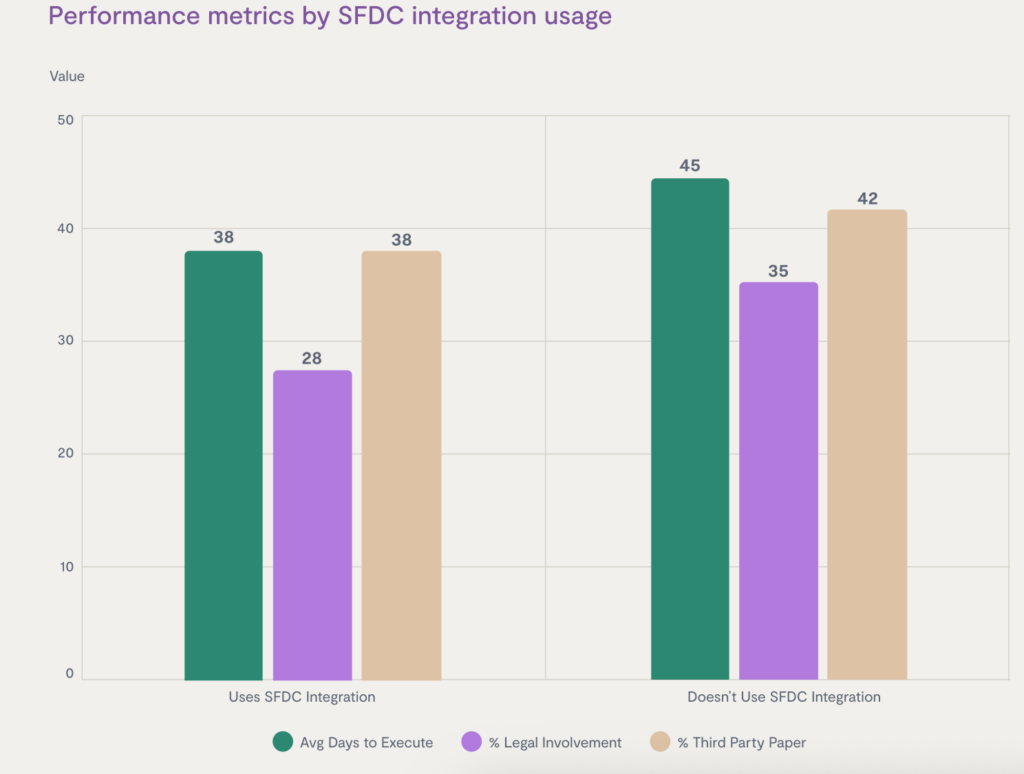
CLMs make your supplier landscape more visible so you can better assess your risk, identify weak spots in your negotiation patterns (like your % of third-party paper, for example), and better manage your contracting process overall. This includes validating the performance of your suppliers to see whether they’re actually meeting your agreements.
Build an integrated tech stack that empowers your team
It’s not enough to just have the technology in place; it has to work with how your team likes to work. A strong governance structure makes the right decisions automatic. Organizations that invest time up front to align on workflows, thresholds, and process throughout the procurement process consistently outperform their peers, according to our research.
For example, teams that integrated their CLMs with Salesforce reduced legal involvement saw 33% better legal involvement rates and 50% less counterparty paper usage than those without.
Source: 2026 Contract Benchmarking Report
Using a CLM as part of your contracting process adds automation and can reduce legal touchpoints. But automation alone doesn’t mean your process will speed up exponentially. Most organizations take six months to move from CLM implementation to meaningful value. (The average Ironclad user takes 178 days.)
Better governance unlocks stronger automation and more usable capacity, even if it means the initial implementation takes longer.
Position yourself with flexibility
Even the strongest contracting processes run into leverage they can’t simply negotiate their way out of. Manufacturers will always have to deal with imbalances of market power and the macroeconomic landscape.
On a contract level, that looks like clauses that allow you to move more freely and make changes within your agreement without needing to renegotiate, such as:
- Volume bands: Define pricing at different volume levels, allowing the relationship to scale up or down without renegotiation.
- Scope variation procedures: Establish clear processes for adding, removing, or modifying scope elements, including pricing and approval mechanisms.
- Change control processes: Define how changes are requested, evaluated, priced, and approved, preventing scope creep while enabling necessary adjustments.
- Technology refresh provisions: For technology contracts, or those where technology is embedded, incorporate new technologies or replace obsolete components.
Contract leakage doesn’t come from your contracts alone, but how you set rules and processes that deal with your contracts when leverage deviates from your expectations. Visibility, limits, and escalation paths must be in place when you’re taking on more risk in the form of counterparty paper (or otherwise), so that you’re doing so deliberately and with intention.
The right CLM can help you build more resilient contracts
A few years ago, contract automation felt like a breakthrough. Today, it’s table stakes. Our data shows that across all industries, not just manufacturing, contract gains are happening more slowly in response to market pressure. And there’s a clear difference between leading teams that are firing on all cylinders with a CLM in place and those that are still stitching together multiple systems to get a picture of their contract landscape.
Learn more about how technology can help you create a flexible, resilient contracting position with the 2026 Contract Benchmarking Report.
Ironclad is not a law firm, and this post does not constitute or contain legal advice. To evaluate the accuracy, sufficiency, or reliability of the ideas and guidance reflected here, or the applicability of these materials to your business, you should consult with a licensed attorney.


