

How In-House Legal Teams Handle High-Volume Contract Review with AI
Where should legal teams start? Consilio’s Alistair Petersen, Director at a global legal services provider, on automating high volume contract review.

Want more content like this? Sign up for our monthly newsletter.
Legal has always been the function that protects the business.
Yet they’re often overwhelmed—and expectations from the rest of their teams have only increased in recent years, according to our 2026 State of AI in Legal Report. 96% of our respondents told us that their organization expects more from them than it did two years ago.
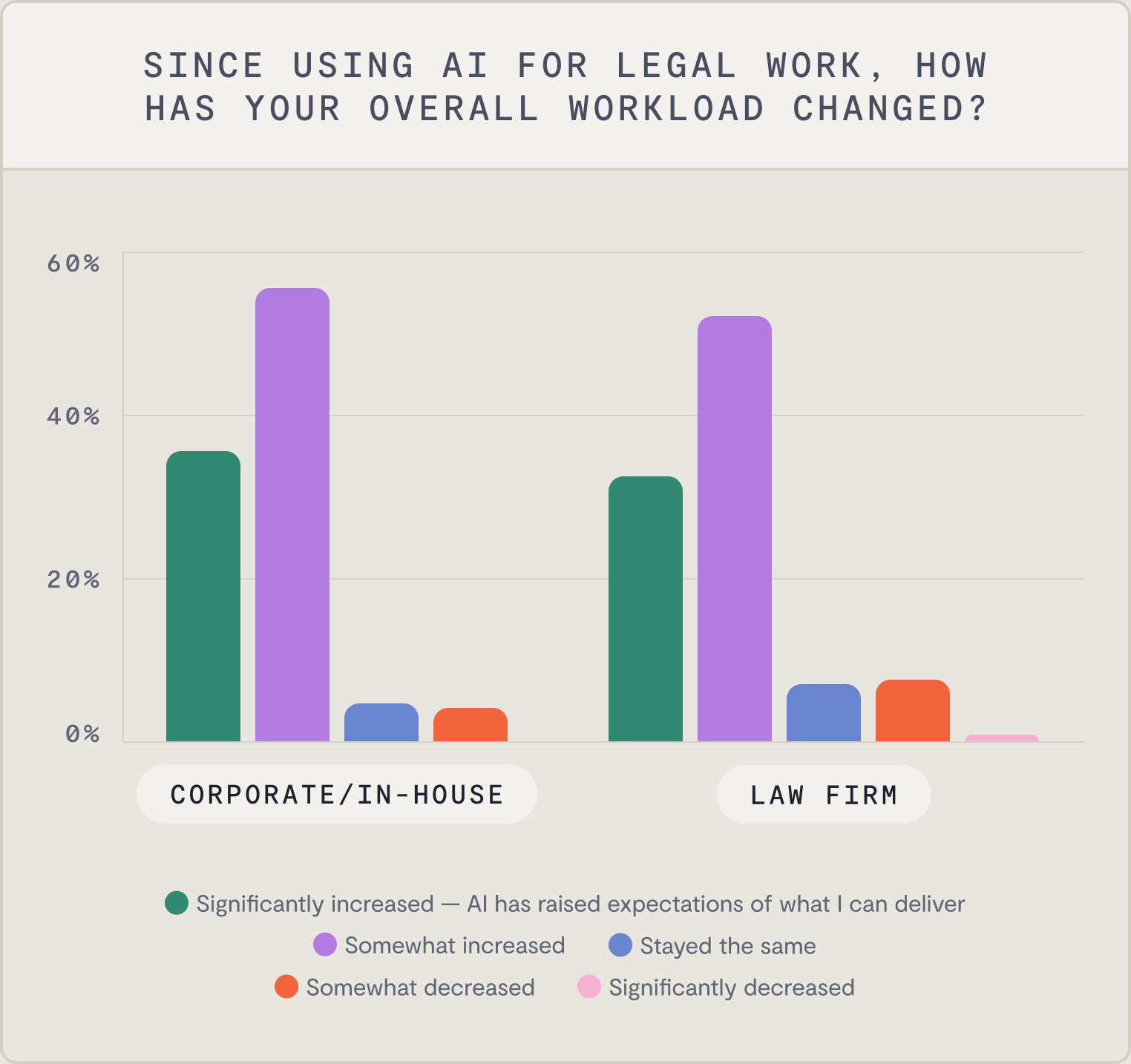
Source: 2026 State of AI in Legal Report
The issue is that while the benefits of AI are obvious—efficiency and speed, namely—teams still need to take the time to do their due diligence with AI outputs. It’s not as easy as pressing a button (yet) especially when it comes to compliance and risk management.
So how can legal teams continue to fulfill their mandate of protecting the business while incorporating AI into their workflow? The answer is to start with high-volume contracts that contain the least amount of risk. That’s why we sat down with Alistair Petersen, Director at Consilio, to talk through how in-house legal teams actually implement high-volume contract review with artificial intelligence.
“AI enablement is great for high volume contract review, removing a potential human-in-the-loop hurdle for business enablement,” he says.
The concerns holding in-house legal teams back
The general consensus (92%) among our respondents was that the benefits of using AI greatly outweighed the risks. But those risks are very real.
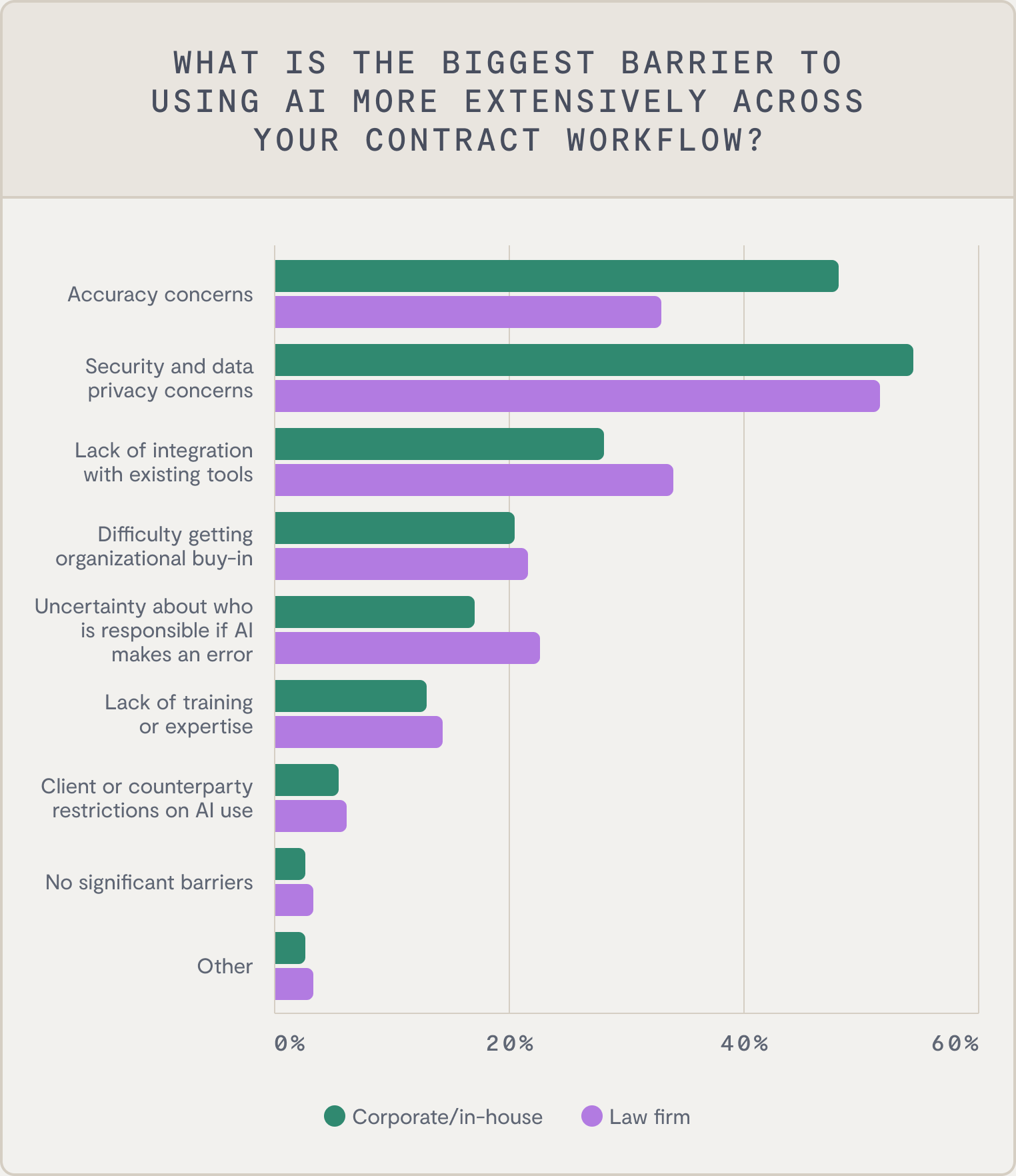
Legal professionals need to trust that the output of their review is accurate. “The primary concerns I’ve seen from clients are about trust and accuracy,” says Petersen. You’ve probably already heard plenty of AI horror stories, like Sullivan & Cromwell’s high-profile AI hallucinations.
In-house teams are already well aware that the stakes are high.
“These are not unfounded concerns as there could be a number of reasons why a review might not perform as desired,” adds Petersen. “Where AI doesn’t fit as well is when the agreements are highly bespoke or where the obligations are technically complex. In those instances, AI will perform with a lower level of confidence in extracting the necessary items with the required accuracy and level of completeness. This is where many of our clients have concerns, when in reality it’s a mismatch between expectations and task choice.”
To mitigate these risks, you can:
- Improve your inputs. The more specific you can make your prompts, the better.
- Make sure your model has enough context. The saying goes, “Garbage in, garbage out.” A generic AI model that has no training about your organization, preferences, or situational context won’t be able to give you the answers you actually need.
- Fix your process. AI requires great data to be useful. If you’re working with a fragmented process with multiple data sources that don’t talk to one another, AI can only do so much.
- Use a dedicated piece of software like a CLM. AI that’s embedded into a system is much more likely to be useful because it has all the organizational context and data it needs to run. For example, if your question is to identify the risk associated with an indemnification clause, that’s much more specific than asking what the risk is in the contract as a whole, or the general risk tied to indemnification clauses. The right CLM can help you use AI more effectively, since it’s programmed with legal teams in mind.
While hallucinations and errors remain a potential risk, they’re becoming less and less common as AI models improve. “As underlying LLMs become more sophisticated, we’re seeing much higher accuracy scores across the board,” says Petersen.
Why high-volume, low-risk contracts are the AI use case legal teams should pay attention to
The concerns teams have about adding AI into their workflows are very real—but part of the issue is trying to use AI for the wrong kind of contracts. What works well is contracts that are repeatable and standardized. You know the ones: The high-volume ones that make for the most boring review tasks.
“Without a doubt, AI is best applied when contracts are fairly standardized and repeatable for the company,” says Petersen. “The more standard and repeatable a contract is, the easier clause and principle recognition is for AI to ‘read’ it.’”
That’s because AI looks at your contracts as raw data ready to be extracted and used. Instead of thinking of contracts as hundreds of words strung together into sentences, it analyzes your contracts on a clause-by-clause basis, looking for patterns and insights. Common high-volume contracts like non-disclosure agreements (NDAs), master services agreements (MSAs), statements of work (SOWs), or purchase orders (POs) are all examples of documents that your legal teams see every single day, and they’re usually the same.
Take NDAs. While there are plenty of complex contracts that require a lot of back-and-forth, there’s rarely anything to push back on with an NDA from either party…yet it takes up a ton of time anyway. Instead of spending time on a contract like this one, you can create a system based on risk, industry, or history of that contract type to use AI to redline the document. That way, you can get 90% of the way there without expending as much effort.
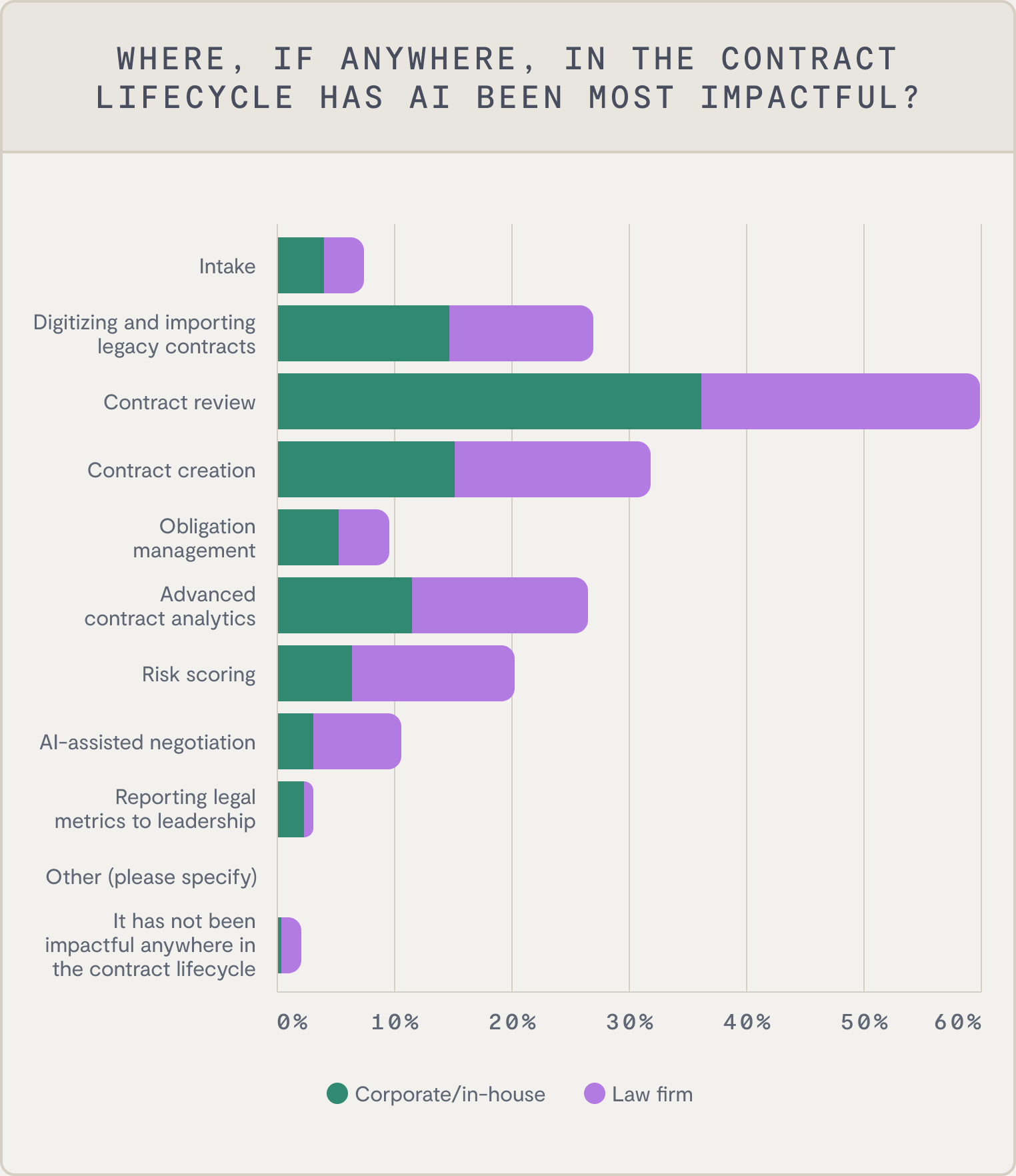
Source: 2026 State of AI in Legal Report
When we asked legal professionals about what tasks AI is most helpful with, contract review came up again and again. With these kinds of contracts, AI can take the first pass performing tasks like:
- Building a standardized template for your entire business to use
- Automatically adding metadata to uploaded contracts so you can organize them in your contract repository by date, signatory, approvals, and department
- Flagging clauses that don’t match your preferred language, and suggesting swaps from a dedicated clause library
“What makes these especially good candidates for AI to handle is not just that they are usually standard, but that they have minor commercial value or risk attached,” explains Petersen. “The first step to success is a great understanding of your contract landscape and how the high-volume AI review performs against it.”
What high-volume contract review with AI looks like in real life
Petersen recalls a client that struggled to keep up with the ever-increasing demands from their team. “Their workload was unbelievable,” he says. “Just two people were tasked with all the NDA reviews for the entire organization—over 3,900 in a single year!”
This kind of repetitive work made it a real grind for their team members, and it was exactly the kind of use case to apply AI in a smart way. “When they set up, tested, and learned to trust the AI output, their work lives were completely changed. Their focus was able to shift from being the fastest first review turnaround to being the fastest compliant conclusion, and that was huge for them,” says Petersen.
Gone was the daily grind, replaced instead by more high-level strategic work. They still needed to review NDAs, but it wasn’t the same kind of drudgery. We’ve found this pattern repeat across many legal teams as they add AI:
When we asked legal teams how their workload shifted with AI, 89% said they increased their time spent on strategic and complex work compared to before. When you’re not rushing through document reviews or scrambling to meet deadlines on routine tasks, you can be more thoughtful about the work you’re doing (and hopefully even enjoy it.)
Where you still need a human in the loop with high-volume contract review
You can outsource most of the high-volume contract review process to AI, but there still needs to be a human in the loop. According to Petersen, the level of involvement depends on a few factors:
- The level of homogeneity of your contracts being AI reviewed,
- The complexity of your business and of the positions you want to adopt, and lastly
- The level of trust in AI output.
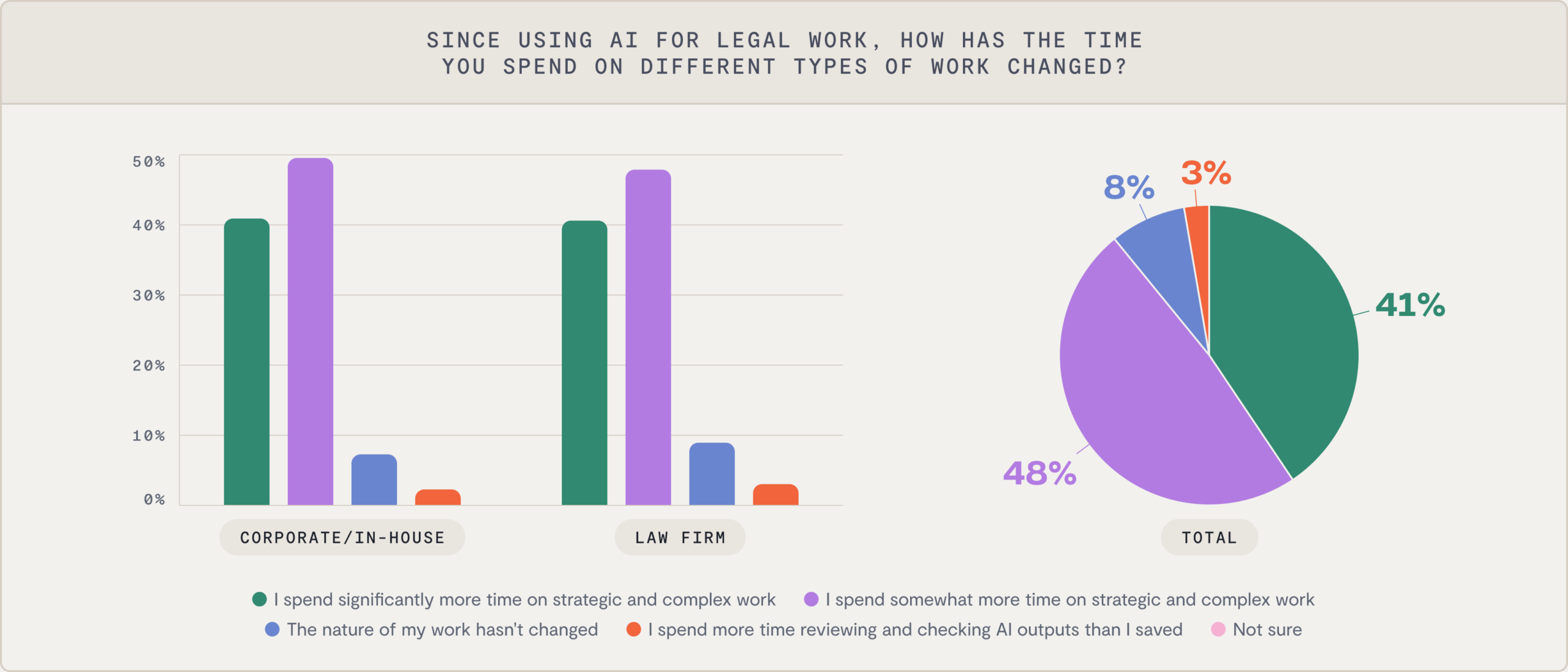
Source: 2026 State of AI in Legal Report
“Ideally we want there to be clarity for the degree of review needed for specific contract types. The correct stance is not for customers to delegate the review fully to AI, but rather to use it as needed, based on the contract library and the risk factors at play,” he explains. “The best outcome is not for customers to have absolutely no need to review the AI output. It’s that they know exactly where the highest risk is in the contract library and where to focus more human effort for the review.”
Get started with high-volume contracts and AI
Your high-volume, low-risk contracts are a natural place to start with AI because they provide building blocks of data that’s easy for it to work with while taking the most boring work off your plate. To get started, Petersen recommends doing a deep dive into your contract library. “We like to start our clients with a trust-building exercise,” he says. “Run various scenarios through AI review to determine your company’s level of confidence under various conditions like industry, client size, or risk. Knowing how to identify and trigger those alerts makes a world of difference to your high volume review, and more importantly, your ability to enable the rest of the business.”
Learn more about how in-house legal professionals are using AI to work smarter, not harder by downloading our 2026 State of AI in Legal report.
Ironclad is not a law firm, and this post does not constitute or contain legal advice. To evaluate the accuracy, sufficiency, or reliability of the ideas and guidance reflected here, or the applicability of these materials to your business, you should consult with a licensed attorney.