



The Roadmap to CLM Readiness for Procurement Teams
Get a roadmap for how to get started in part two of this series on CLM readiness in procurement.

Want more content like this? Sign up for our monthly newsletter.
One thing all procurement professionals can feel right now? Pressure.
“I know plenty of procurement teams who are struggling because they’re asked to do more with less, and because the business is saying, ‘Do your job, but do it even faster and even better, and we’re not going to give you any more people to get it done,’” says Tom Mills of Procure Bites.
This pressure is coming from all sides:
- Internal pressure from executives to do more
- Supply chain pressure from geopolitical events
- Macroeconomic pressure from inflation, tariffs, and taxes
- Market pressure from new technology and upgraded customer expectations
Most systems aren’t designed to handle this much pressure at once. Take your contracting workflows, for example. You may be able to move a deal forward but if it takes a committee to approve and sign it after Slacks, emails, calls, and meetings…it’s no wonder procurement teams are struggling.
The solution to this is a contract lifecycle management tool, or CLM. CLMs centralize your contracts and make them searchable so you can surface insights about your performance, suppliers, and deals to help your team move forward more quickly—and help you better manage your suppliers. A great CLM integrates with existing supplier relationship management systems, too, so there’s one system of record for all of your contracts.
In part one of our two-part procurement readiness series, we talked about how to know if your team was ready for a CLM. Today, we’ll cover a roadmap to CLM implementation that gets your team aligned from the get-go. This includes evaluating your overall process, change management, and the final prep before launch.
The first 30 days: Establishing a baseline
Before you begin, you have to know where you’re starting from. This means taking stock of your entire contracting workflow—not just where procurement comes in—so your teams know:
- What types of contracts you handle the most
- What workflows exist, if there is more than one process or if they’re separated by team
- A stakeholder map of teams that need access to the CLM
- Your overall performance metrics, such as approval times per function, majority spend suppliers, RFP turnaround, and overall return on investment.
From there, you can assess the gaps that exist in the process. The most common gap? Collaborating between stakeholders. Says Tom, “Stakeholder engagement is still a challenge for many procurement teams, just to actually be involved at the right time so they can show where they add value. Stakeholders are becoming increasingly time-pressured, busy, and just want to get on and do it themselves, which creates a real friction within the organization. It’s impossible to do more with less if you’re not at the table in the first place.”
You can’t jump straight to implementation without taking this step. That’s because the reason contracting becomes an issue for procurement teams is often a people or process failure, not a technology one. A CLM will certainly help streamline the process, but if you’ve got contracts stored in a bunch of different places, or an indifferent wider organization to procurement’s value, then you have bigger issues to solve before you put a new technology solution on top.
Days 31-60: Prioritization and alignment
Once you know more accurately what contracting looks like for your team and stakeholders, it’s time to make a plan. Many CLMs come with automated workflows that can assist with certain types of contracts, like a supplier agreement or purchase order. Says Mills, “It’s important to evaluate any solution by what your team needs now, and what they need in the future. To get adoption from your team, you need to fix their current problems first.”
You’ll want to prioritize the highest volume contracts that run through your team first for your pilot workflow in the next phase. Yes, they’re all important. But your team must align on which workflow you’re going to use as your pilot, so choose only one or two.
Then, come up with a standard practice for all contracts. What does the ideal flow look like for intake or approvals? An example of a simple flow would include:
- Identify the need for a good or service → Submit a purchase request to the procurement team.
- Procurement + stakeholder works together to source and select a vendor.
- Once a vendor is selected, the procurement team negotiates the deal and signs the PO.
- Delivery or implementation takes place, and the procurement team handles the payment process and recordkeeping for the future.
- Stakeholder reports back on implementation, including adoption and reporting on success using the new good/service as a team.
Days 60-90: Pilot and launch preparation
This is where your solution finally takes shape. Early on in this block, your engineering team should stand up pilot workflows and begin to test out the implementation, including pressure-testing handoffs between teams. What features are missing? What’s still broken? Where are the gaps? Beyond basic debugging, you’ll want to take a big-picture approach to the new solution to understand whether or not it will work at scale.
Then, it’s time to ramp up your change management. Learning a new system can be confusing for team members, even if it’s super intuitive. Train any core users and cross-functional partners first—not just in the tool itself, but in the overall process you’re going to run with so everyone is on the same page.
Then, make sure your reporting is locked down. Are the data flows working? Is it syncing to your supplier management system? The value of a CLM is in the visibility and access to your contract data, like renewals, obligation, cycle time, and savings. If you can’t see that, or don’t know how, then it’s time to slow down.
If everything is working, then the last piece of this phase is identifying how you’ll scale the system into additional workflows and governance, like adding artificial intelligence.
Don’t fall for these common CLM implementation errors
It’s exciting to finally onboard a piece of technology that will make your life easier. But don’t make these mistakes:
Thinking the technology can solve a broken workflow
No matter how great a piece of software is, it can’t make up for gaps in your workflow, or a process that has no stakeholder buy-in. “I think there are many procurement teams that function more as a purchasing process, and that’s exactly what will become so automated and easy that you’ll start to question the role of procurement at all,” Tom says. “The teams that make it clear to their broader organization that they’re a strategic partner that drives impactful decision-making and revenue, that’s what’s going to make a difference.”
Take artificial intelligence, for example. Adding AI into your procurement workflow can have tremendous benefits—across procurement teams we surveyed for in our 2025 State of AI in Procurement report, the average benefit score is 8/10.
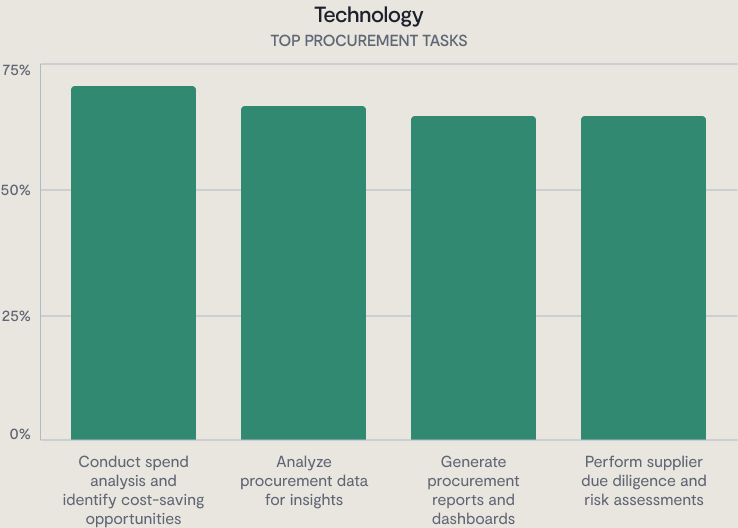
Source: State of AI in Procurement 2025
Common AI use cases include generating reports and dashboards (63%), drafting and defining technical requirements (63%), and data analysis (62%). But adding AI into a broken workflow won’t fix any of your problems or realize these very real benefits.
Skipping data management
Technology is only as good as the data it can use. So if your contracts are in several different places, it’s time to find them so they’re usable and searchable. To do this:
- Start off by importing your files by record type so that everything has a digital record. With Ironclad, you can bring in as many as 2,000 contracts at a time.
- With existing contracts, look for commonly used clauses that often require discussion—things like limitation of liability, indemnification, or termination rights. Set up flags for these clauses so you can find patterns in existing agreements and see what percentage of preferred language you have already.
- From there, a CLM can look for other patterns, like which contracts are up for renewal, which agreements have lapsed, and assess supplier risk.
That also means cleaning up your contract metadata and making sure that it’s standard across all of your contracts. Your team must fill out these data points when uploading contracts into the system, or you won’t realize any value from it. That way, you can build a clean list of current vendors by agreement type, supply category, or department. Not only does this make moving forward significantly easier for your team, you’ll also be able to mine your contracts for greater business impact, which we’ll talk more about below.
No clear owner of the process
We often think of CLMs as a legal tool, but it’s incredibly valuable for procurement, IT, sales, and finance, too. With so many seats at the table, it can be challenging to align on a workflow and prioritization list that works for everyone. Make sure there’s a clear owner for this implementation, just as there would be for any new major supplier onboarded.
Says Tom, “If we think about all of the challenges facing procurement professionals today, from their supply chain to inflation to AI, what businesses really need are strong, influential procurement professionals that can lead the business to make the right decisions.”
What a successful CLM implementation looks like for procurement teams
A successful CLM implementation can completely change how procurement approaches contracts with their suppliers. Not only does it give you better visibility into your supplier commitments, it allows your team to speed up administrative tasks slowing them down.
Think back to some of the pressure that squeezes procurement teams today. So much is outside of your team’s control, like changing regulations, for example. Suddenly, you may or may not be compliant across your suppliers, depending on the area of the change, such as new tariffs or data privacy changes like GDPR in Europe. A great CLM will help you find weaknesses within your existing supplier commitments, flag any upcoming renewals or re-negotiation strategies, and analyze thousands of contracts for patterns so you don’t have to read every single one to figure out whether or not you’re still in compliance.
Think of it like a pressure valve for your team so you can actually get more done, faster.
Learn more about successful CLM implementations with our case studies.
Ironclad is not a law firm, and this post does not constitute or contain legal advice. To evaluate the accuracy, sufficiency, or reliability of the ideas and guidance reflected here, or the applicability of these materials to your business, you should consult with a licensed attorney.


